Research Interests
Deepsea Fishes
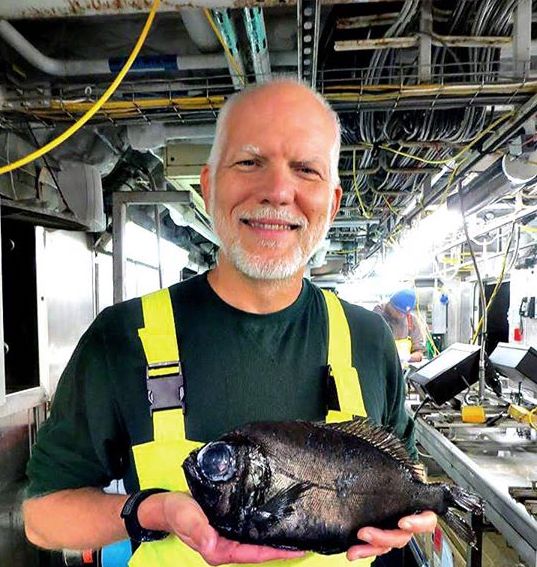
One area of my research is in the biology of fishes, particularly deepsea fishes. I am using still and video imagery to discover deepwater fish behavior, such as upside-down swimming in a deep-sea anglerfish (Moore 2002). My colleagues and I have discovered several new species of fishes during our studies (Merrett and Moore 2005, Moore and Dodd 2010).
Deepsea Fishes of the North Atlantic
I have investigated the distributions of deep-sea fishes in the North Atlantic Basin (Kiraly et al., 2005) and found various modes of dispersal are involved in creating a diverse deepwater fish fauna off New England (Moore et al. 2003b, Moore et al. 2004). In addition, my colleagues and I have studied the small-scale distributions of fishes in relation to bottom types and structural elements, such as corals (Auster et al. 2005). Recent papers of ours have highlighted behavior in the false boarfish (Neocyttus helgae) and juvenile cusk eels associating with pancake urchins (Moore et al. 2008, Moore and Auster 2009).
Fisheries Identification Sheets
I have also been interested in deepwater fishes as resources for fisheries (Moore 1999a, Moore and Mace 1999, Moore and Gordon 2003). I have written several sections of the FAO species identification sheets for three fishery areas, the western central Pacific (Moore and Paxton 1999), western Central Atlantic (Moore 2002), and eastern central Atlantic (Moore in press) and a few sections in the book Bigelow and Schroeder’s Fishes of the Gulf of Maine (Moore 2002, Moore and Klein-MacPhee 2002, Moore and DeWitt 2002).
Antarctic Fishes
I have also worked on fishes found in the Southern Ocean around Antarctica. The main goal of our AMLR cruise in 2009 was to examine the rebound of fish populations after a 20-year moratorium on commercial fishing around the South Orkney Islands. We examined the diversity and size distribution of species, diets, and reproductive activity in the fishes we captured. We also found what appear to be two undescribed species of fishes (Jones et al. 2009).
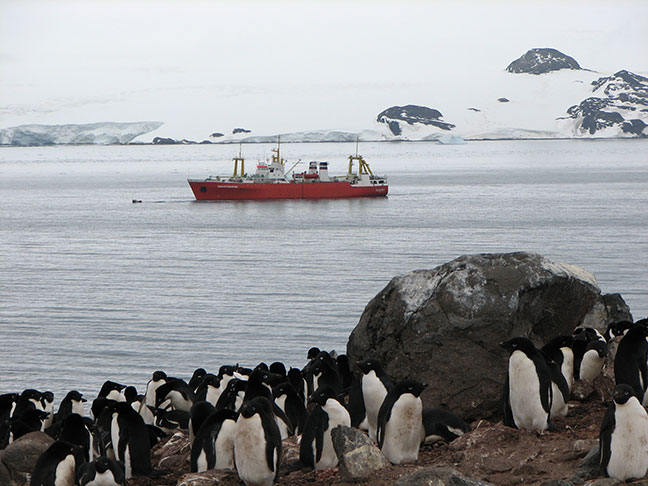
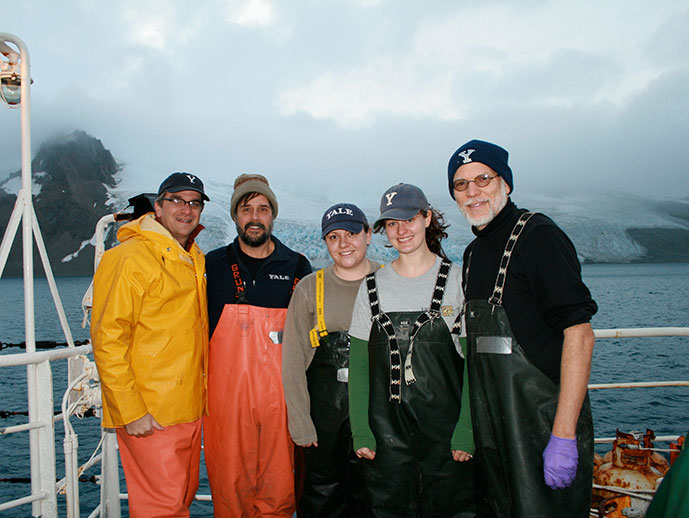
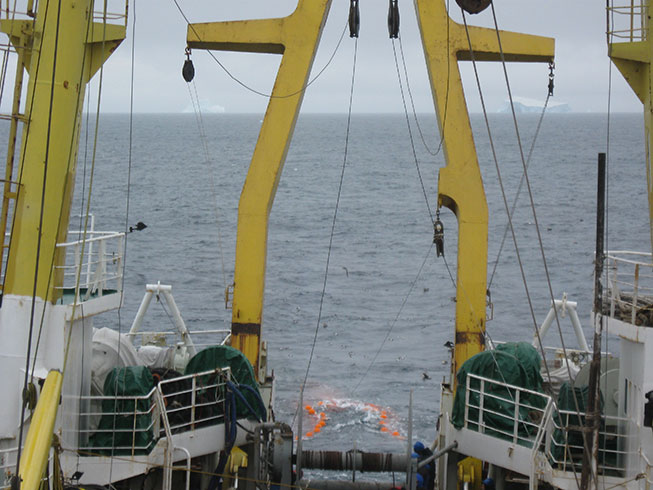
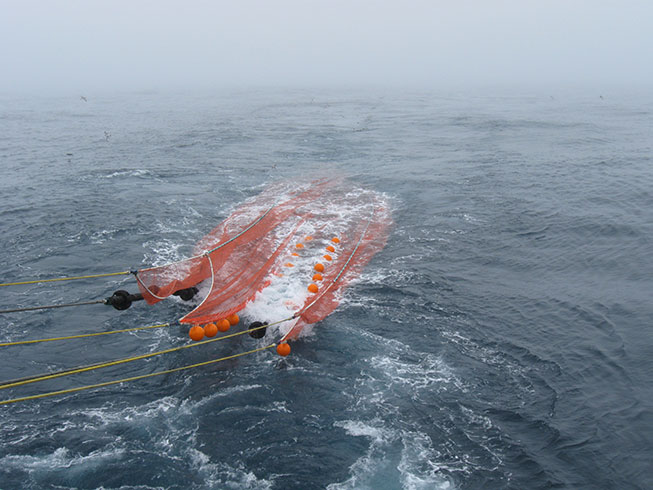
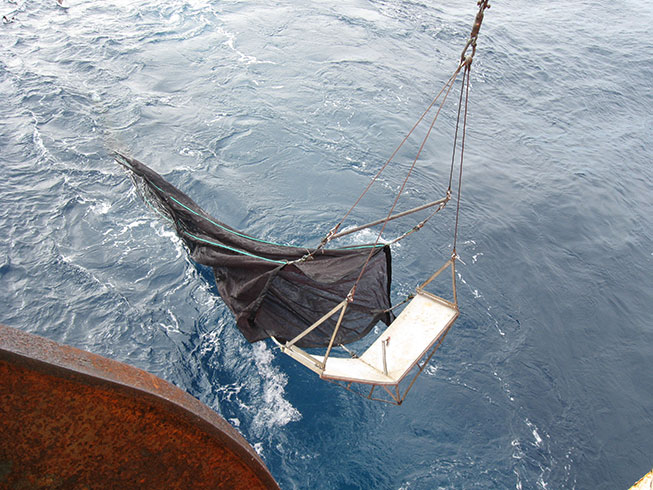
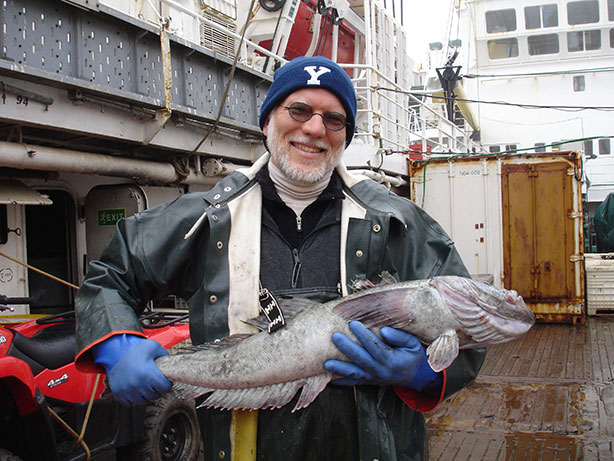
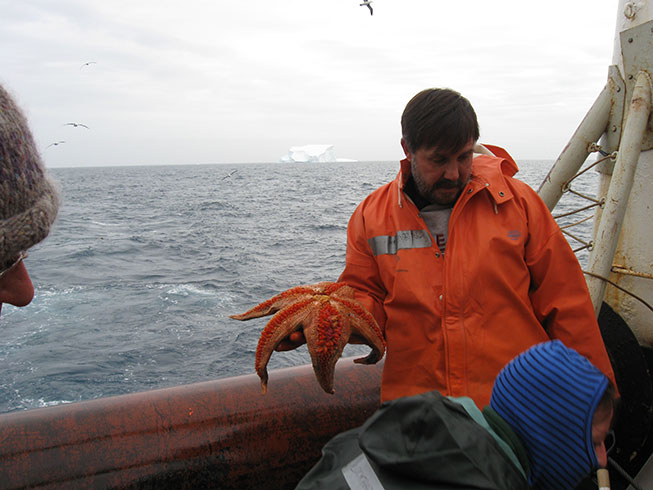
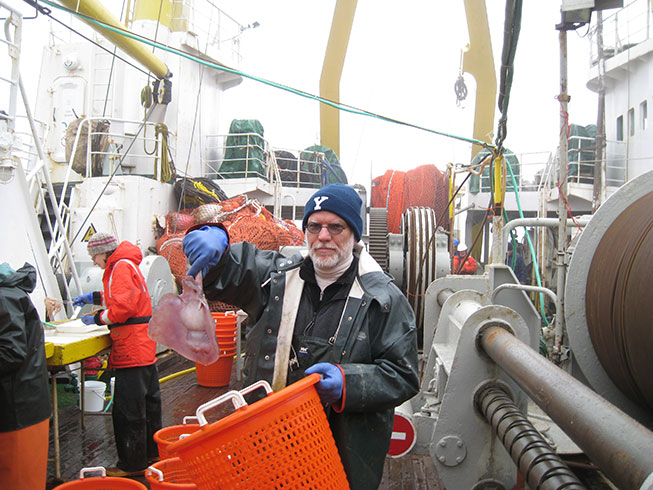
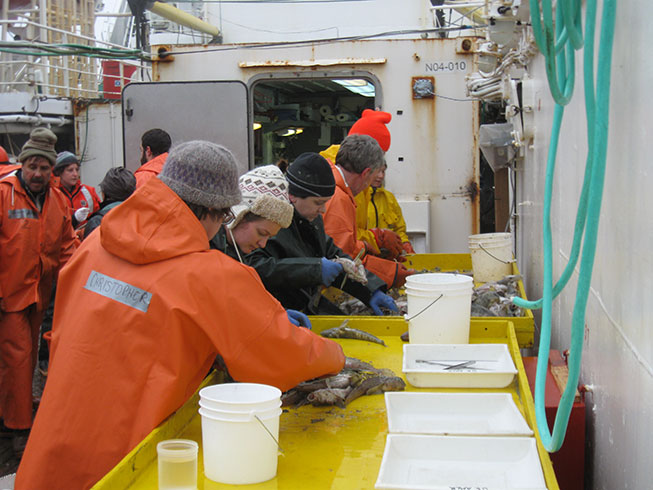
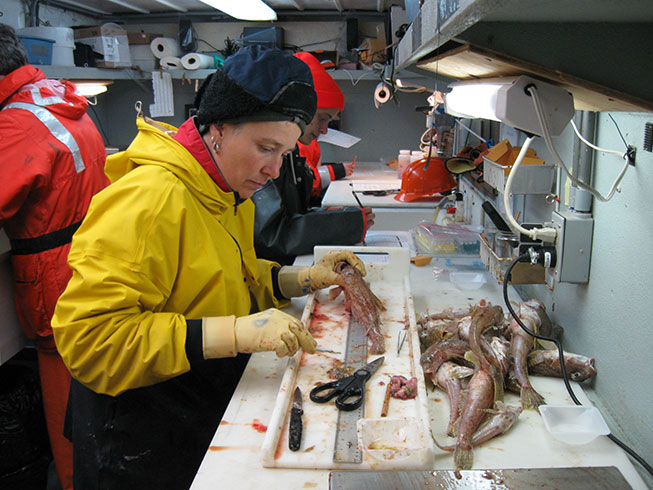
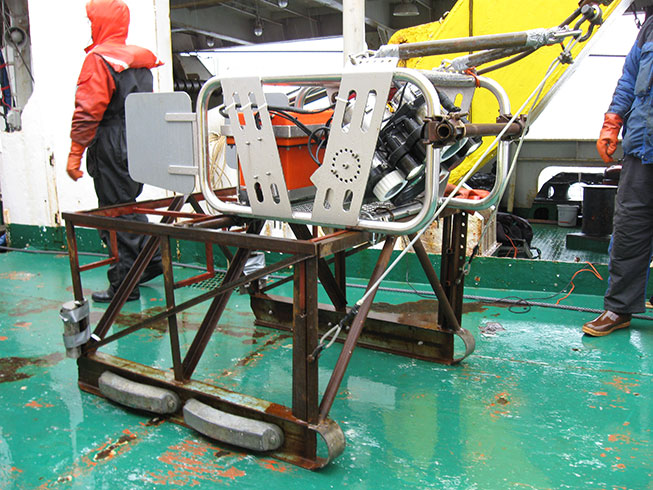
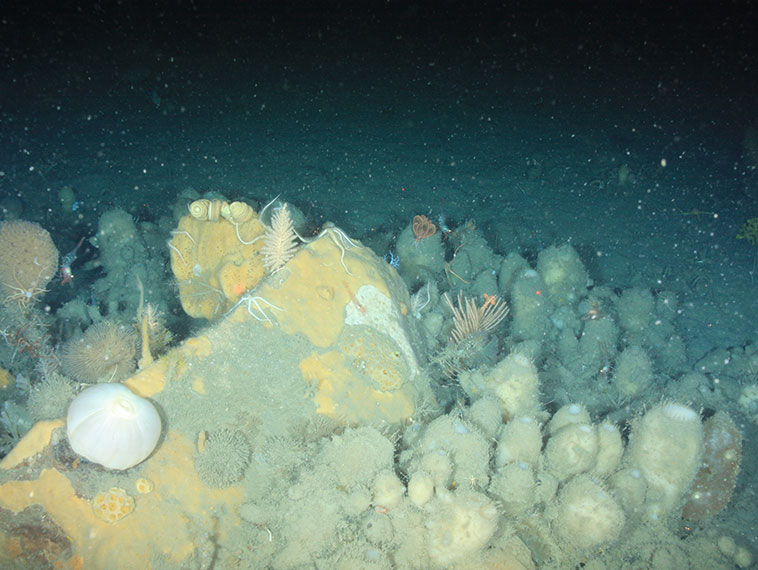

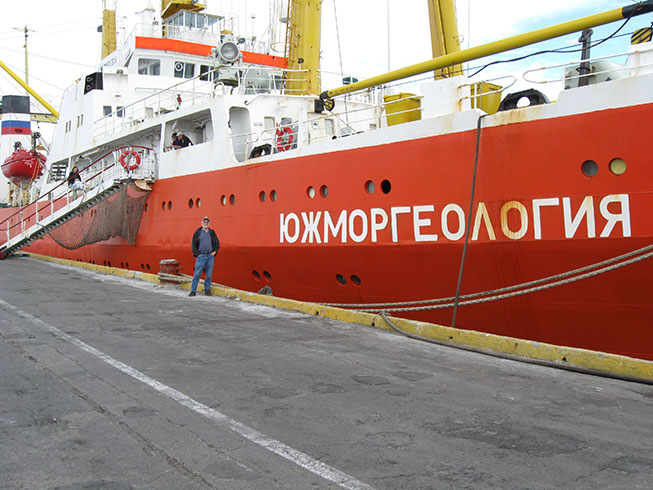
Descriptions of images above. From left to right: Fig. 1: Photo of the RV Yuzhmorgeologica anchored off Antarctic Peninsula with Adelie penguins in foreground. Fig. 2: Scientists associated with the Yale Peabody Museum. Fig. 3: Deploying the bottom trawl net from the A-frame. Fig. 4: Retrieving the bottom trawl net. Fig. 5: Deploying the Isaacs-Kidd midwater trawl (IKMT) net. Fig. 6: Jon Moore holding an Antarctic toothfish. Fig. 7: Eric Lazo-Wasem holding a large seastar. Fig. 8: Jon Moore holding a basket of skates. Fig. 9: Sorting the catch in the fish van. Fig. 10: Kim Dietrich measuring fish. Fig. 11: Camera sled nicknamed the "Ski Monkey". Fig. 12: Underwater photo of a sponge-tunicate reef. Fig. 13: View of icebergs with Cape petrels in the foreground. Fig. 14: Jon Moore standing next to the RV Yuzhmorgeologica in port in Punta Arenas, Chile.
A side project that I carried out during the Antarctic cruise resulted from a special request made by a couple of botanist friends who asked me to collect specimens of one of the two flowering plants known from Antarctica, Colobathus quitensis, a.k.a. the Antarctic pearlwort. I successfully requested and received permits to collect two specimens which I collected from a site near the Copacabana Field station on King George Island. In the slide carousel below, Figure 5 is a photo of an orange glove on the ground with the finger pointing to one of the specimens that I collected. These specimens, along with several photos of them and the setting around them, are now deposited in the botanical collection at the Peabody Museum of Natural History at Yale University (YU.100094 & YU.100095).
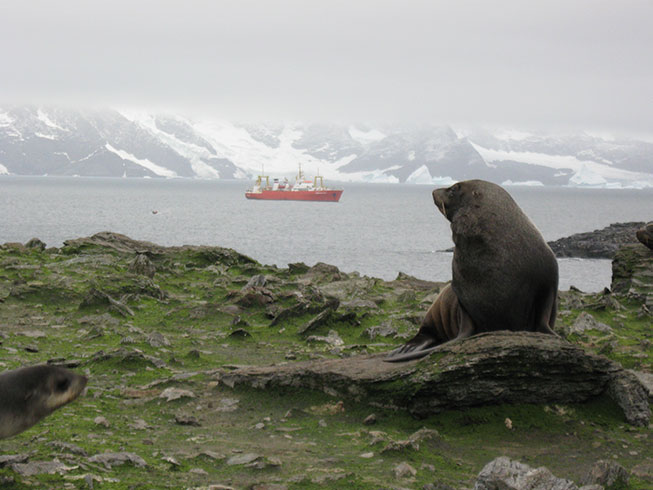
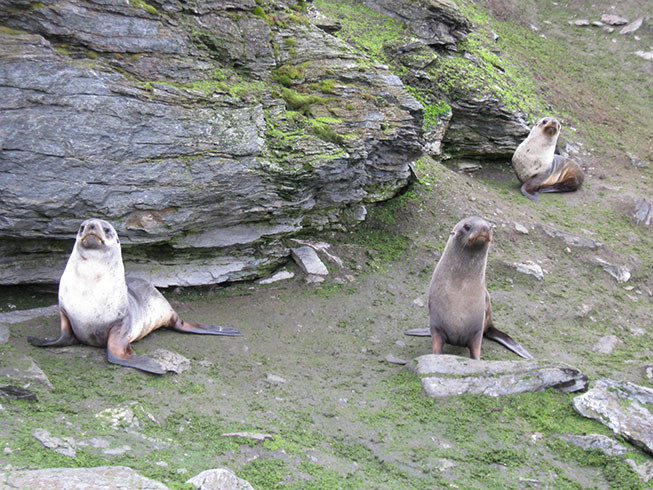
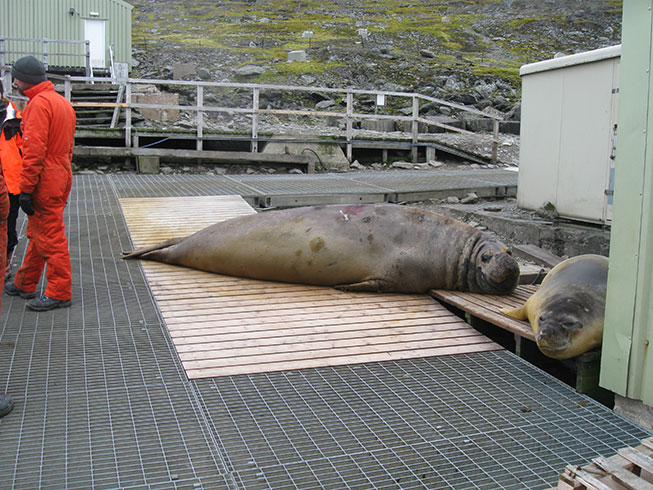

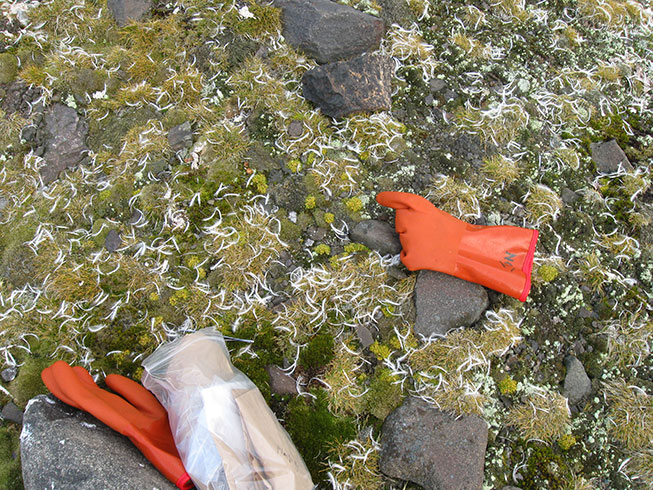
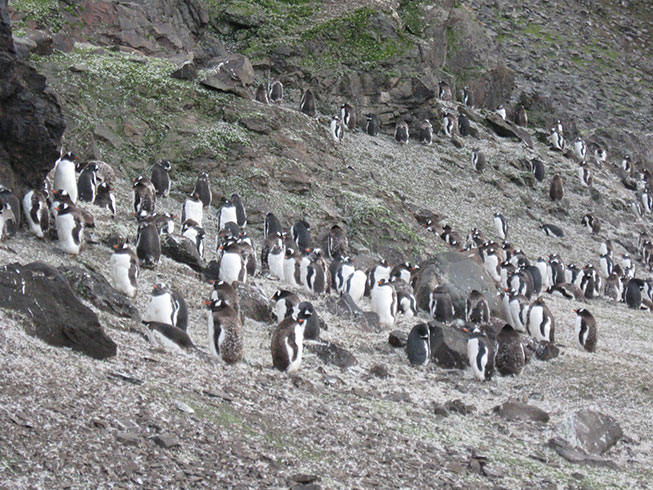
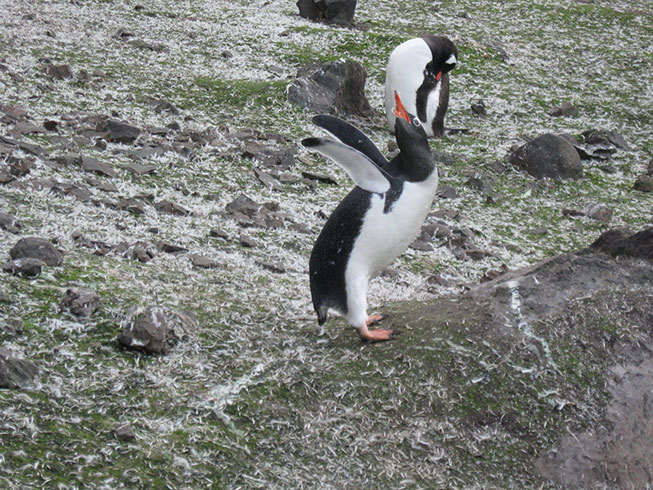
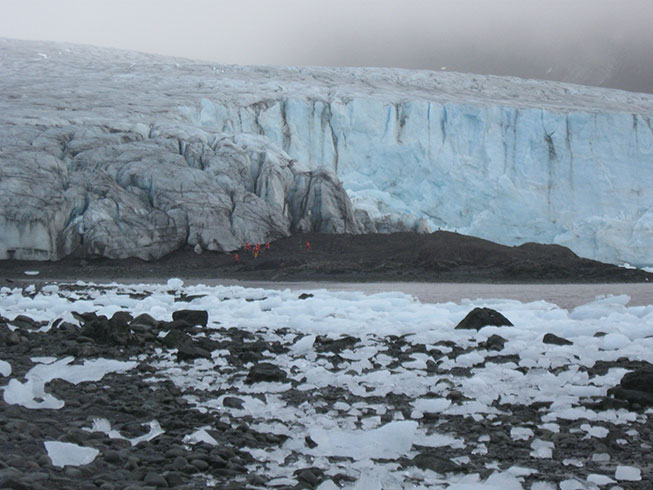
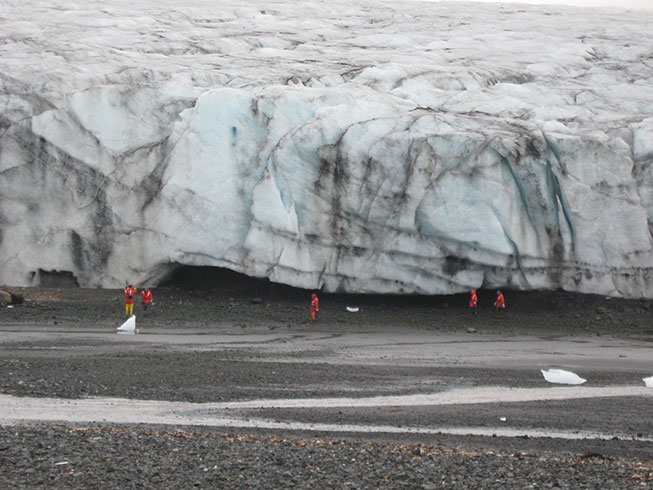
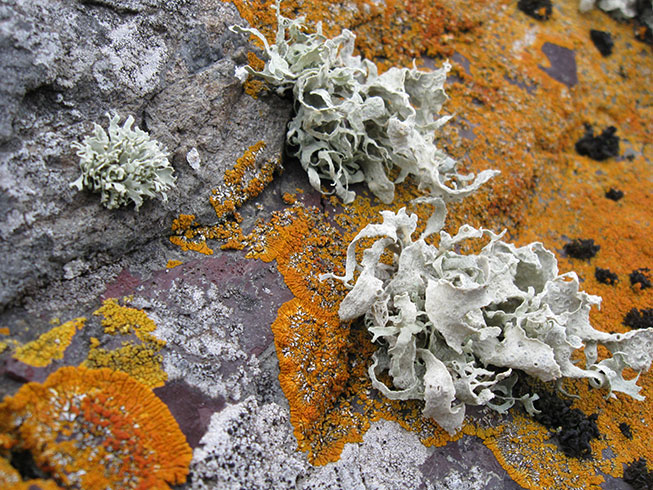
Descriptions of images above. From left to right: Fig. 1: Photo of the RV Yuzhmorgeologica anchored off Signey Island, South Orkney Islands with fur seals in foreground. Fig. 2: Fur seals on Signey Island, South Orkney Islands. Fig. 3: Elephant seals lounging on the deck of the British Antarctic Survey station on Signey Island, South Orkney Islands. Fig. 4: Copacabana Field Station, run by the U.S. Antarctic Marine Living Resources (NOAA Fisheries) on King George Island, Antarctica. Fig. 5: Collecting Colobanthus, a flowering plant growing near the Copacabana Field Station, on King George Island, Antarctica. Fig. 6: Colony of Gentoo penguins on King George Island, Antarctica. Fig. 7: Gentoo penguin displaying, King George Island, Antarctica. Fig 8: Scientists examining Ecology Glacier, King George Island, Antarctica. Fig. 9: Scientists standing near Ecology Glacier, King George Island, Antarctica. Fig. 10: Foliose lichens growing on beach rocks, King George Island, Antarctica.
The DEEPEND Project
Since 2011, I have been studying the deepwater fishes in the vicinity of the Deepwater Horizon oil spill in the northern Gulf of Mexico. Read Secrets of the Deep by Chelsea Matheson. For the past 14 years, the DEEPEND consortium has been studying the effects of this massive oil spill on the deepwater ecosystems of the Gulf, water below 1500 meters in depth. During the spill, BP Exploration & Production, the operator of the Deepwater Horizon, used a chemical dispersant to emulsify oil and turn it into fine microdroplets. NOAA, the National Oceanographic & Atmospheric Administration, realized the scope of the impact on the deep sea when follow-up exploration found a river of oil droplets at 1,100 to 1,200 meters down that extended 250 miles towards Texas.
Working together with a team of researchers in the DEEPEND consortium, we have been investigating the long-term impacts of the oil spill on the marine organisms that inhabit the deepwater marine ecosystem of the western Gulf of Mexico. One of the largest animal migrations on the planet occurs every day between the deep sea and the surface as deepwater animals during the day travel 400 to 600 meters up and down the water column to feed near the surface at night. Whales, sea turtles and sea birds, as well as prized gamefish like yellowfin tuna and swordfish all feed on these great migrators.
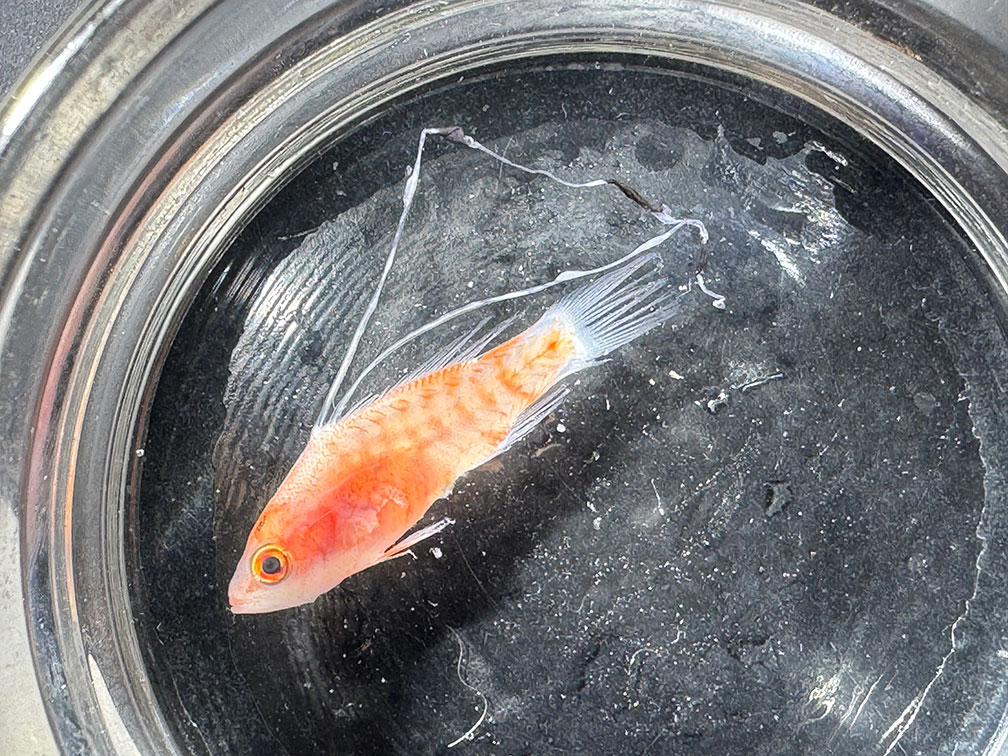
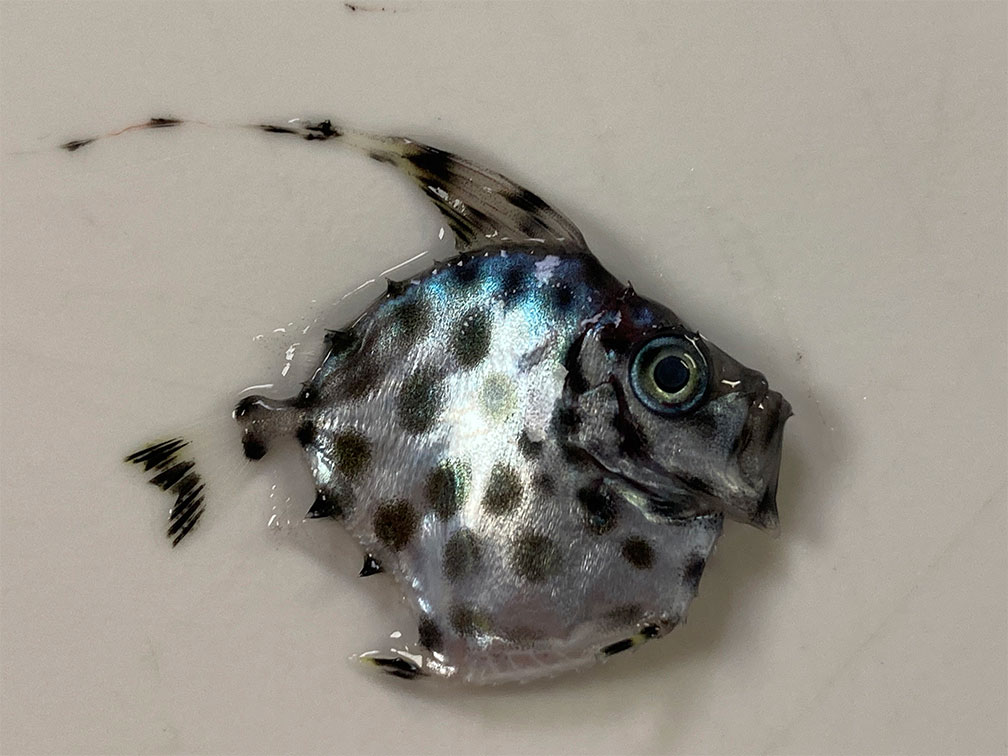
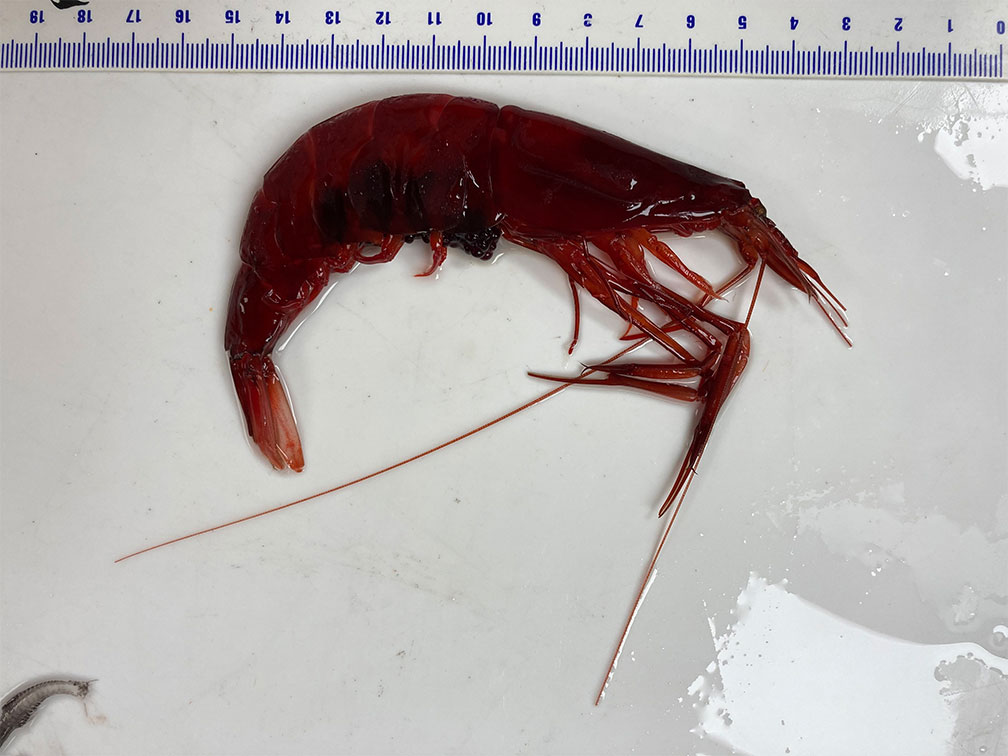
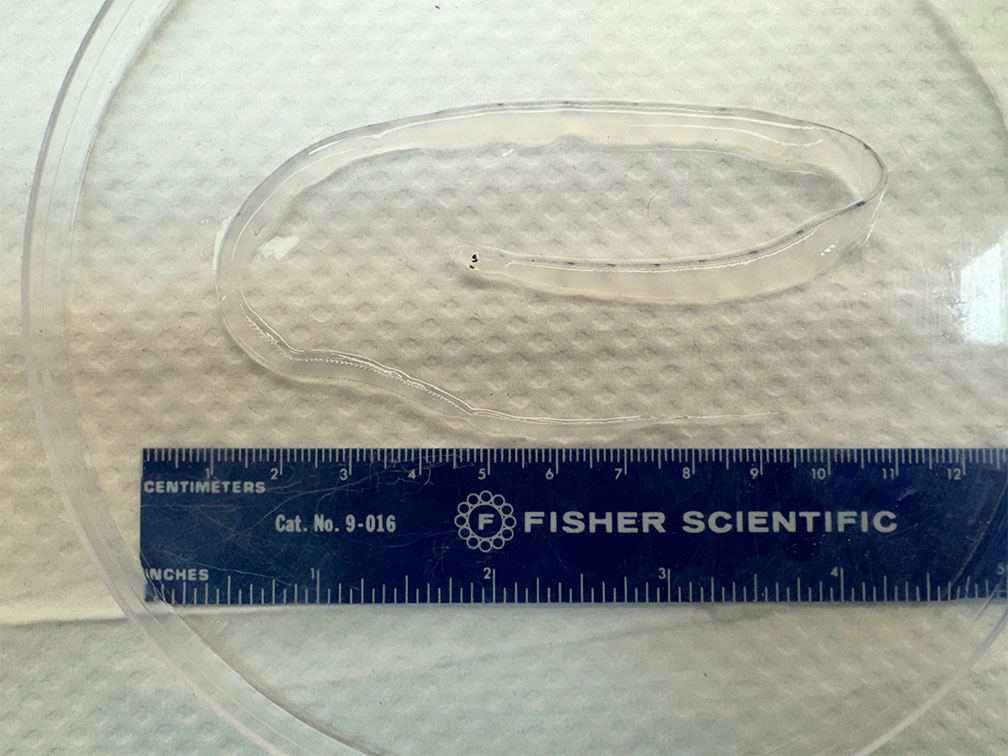
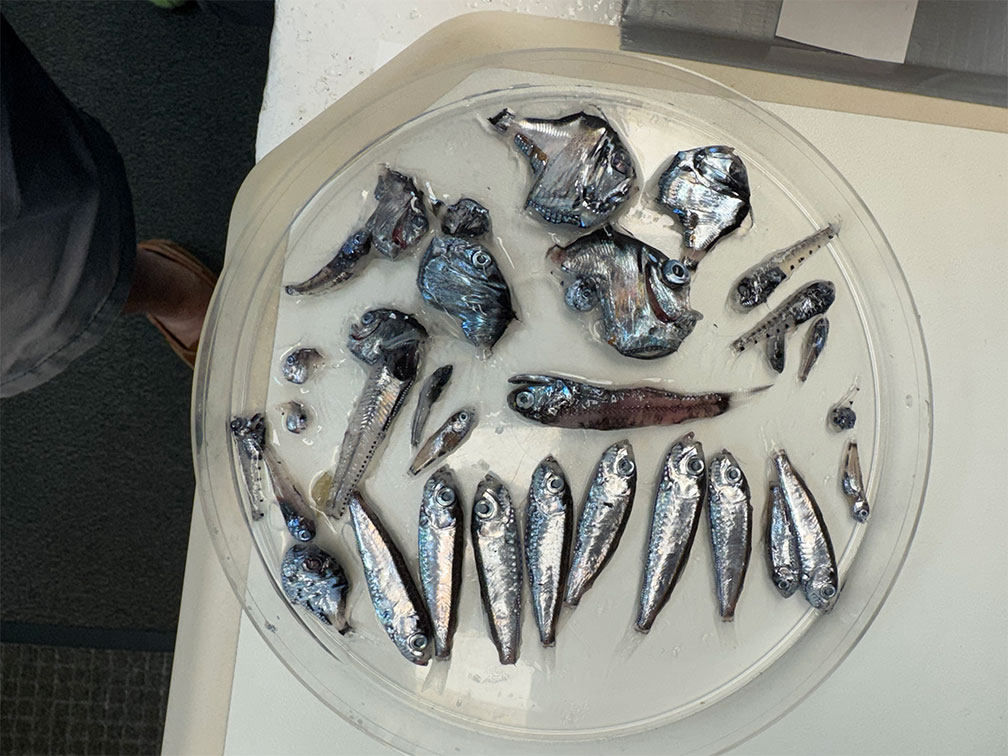
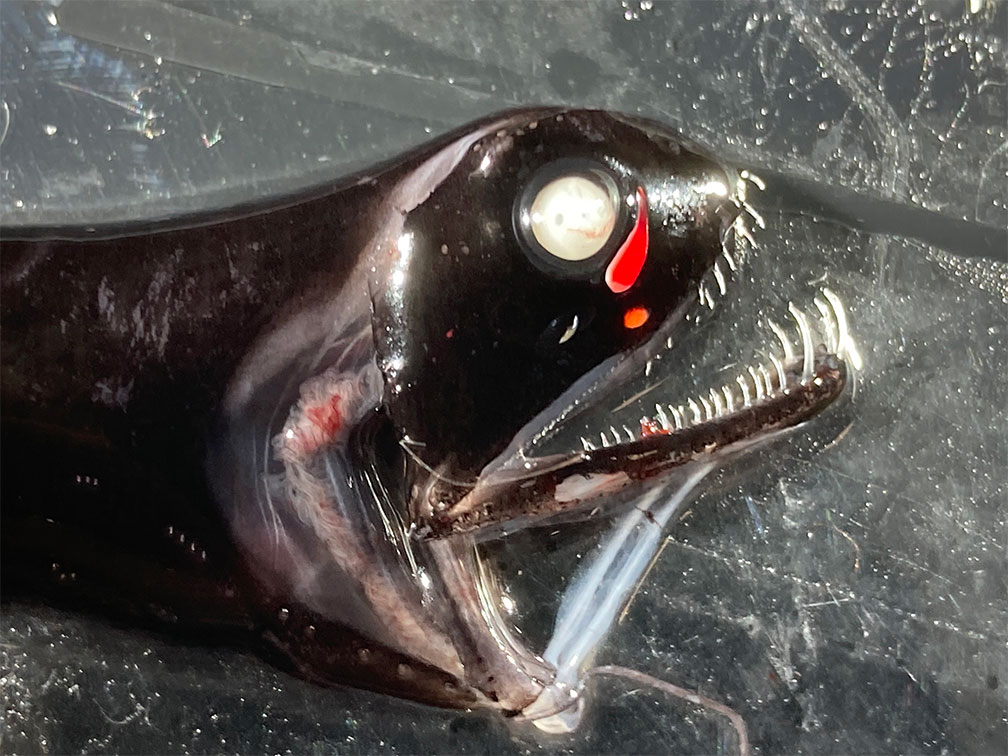
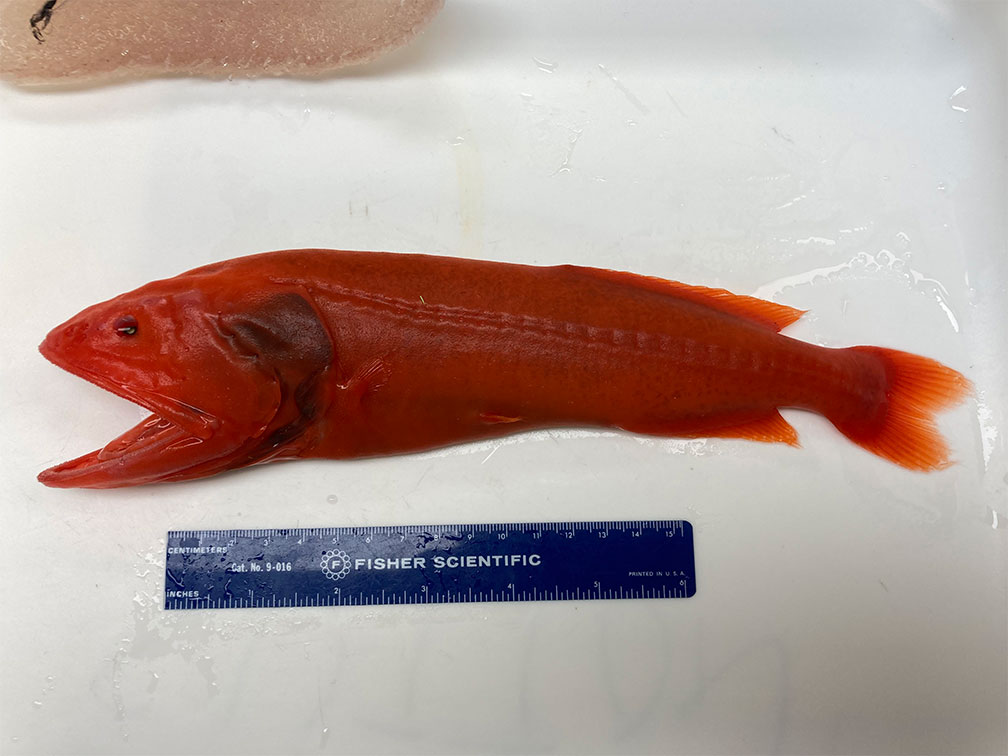
Descriptions of the deepsea critters in the images above. From left to right: Fig. 1: A baby basslet in the genus Liopropoma. Fig. 2: A baby Buckler Dory (Zenopsis conchifer). Fig. 3: A big shrimp. Fig. 4: A halosaur leptocephalus larva. Fig. 5: A dish containing hatchetfishes, lanternfishes, and pearlfishes. Fig. 6: A loosejaw with red light organs. Fig. 7: A red velvet whalefish.
The main trawl we use is the 10 m,2 MOCNESS net frame (a.k.a. MOC10). The MOC10 is fitted with 6 nets that can be opened and closed remotely at different depth ranges in the ocean. By deploying the trawl twice a day, centered around solar noon and solar midnight, we can investigate which animals are vertically migrating from the depths to the surface and back and which animals are non-migrators.
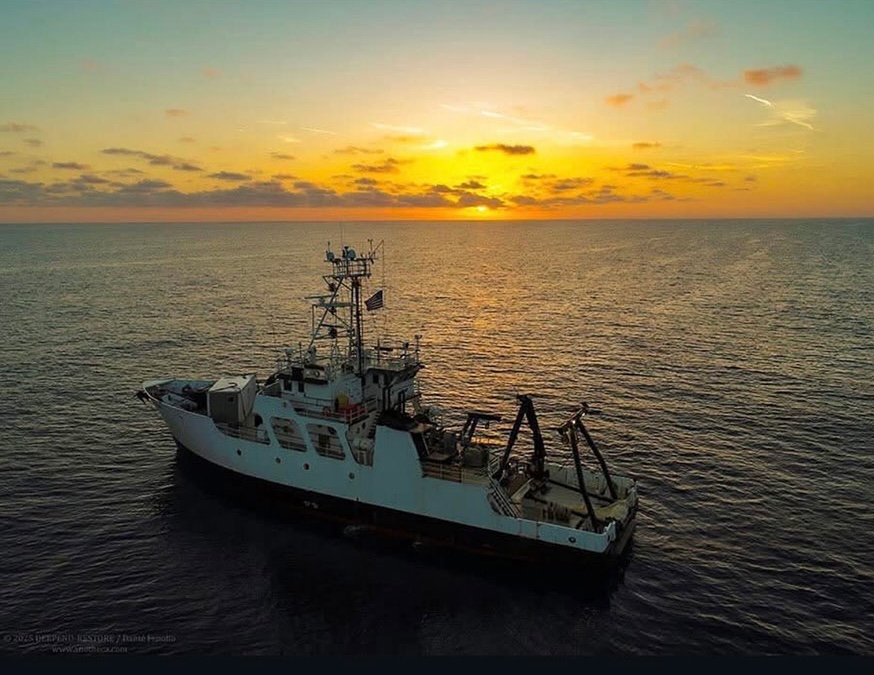

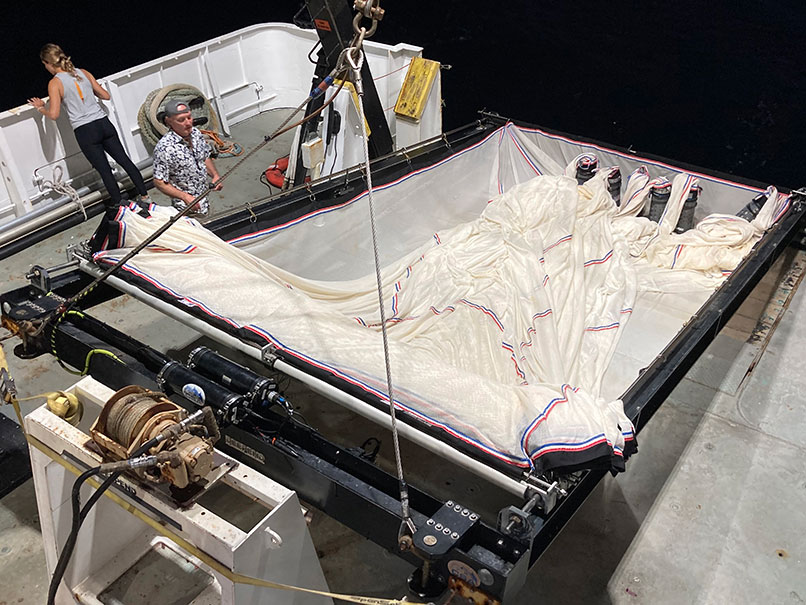
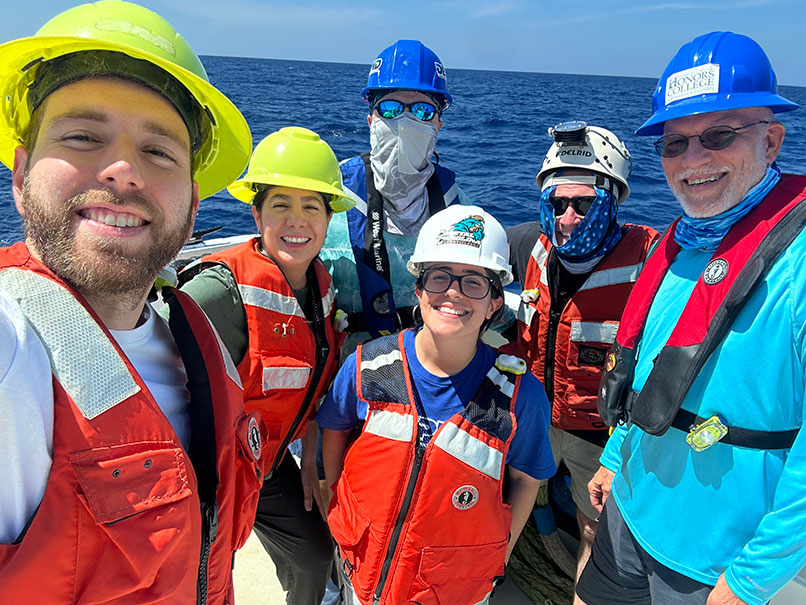
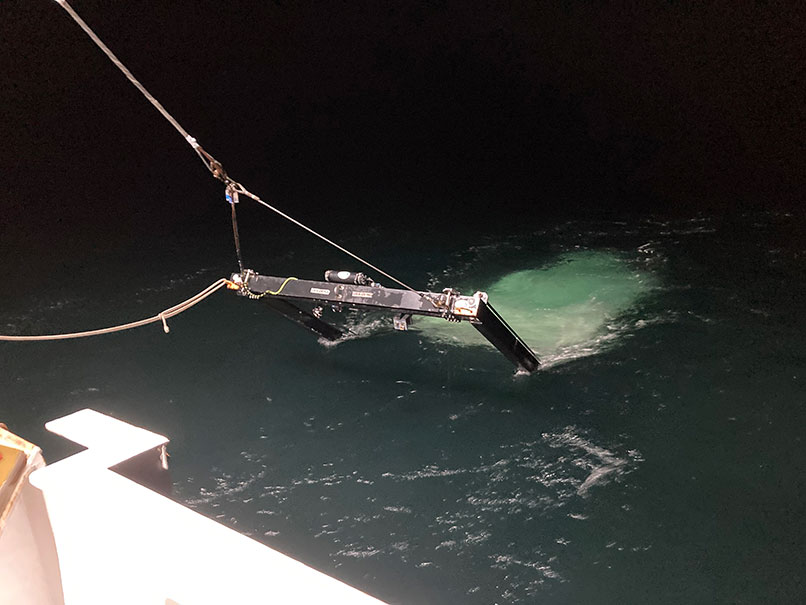
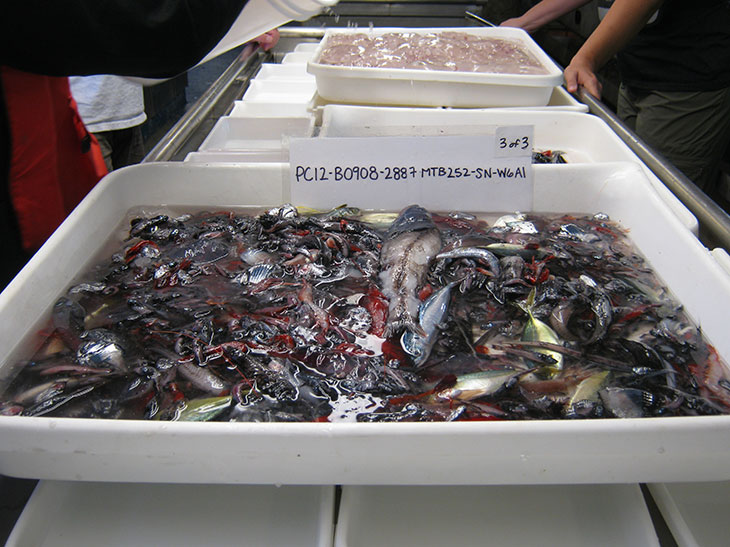
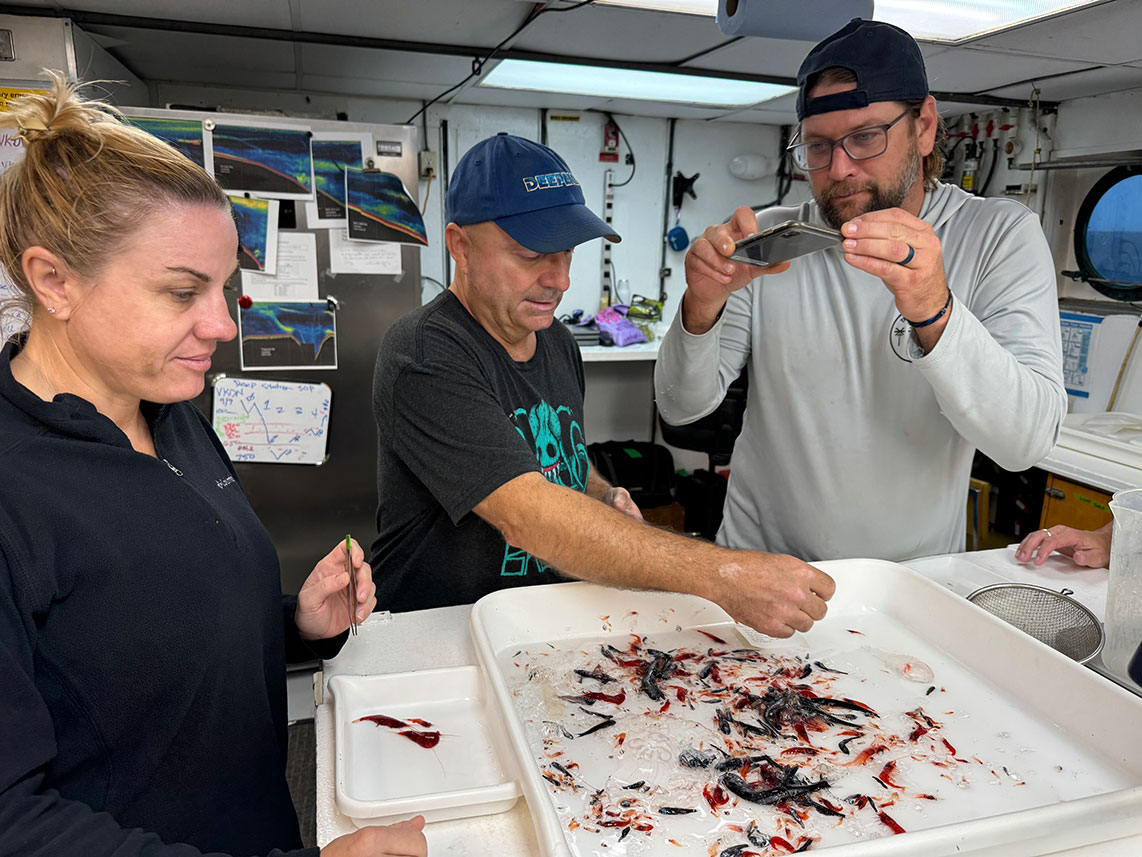
Descriptions of images above. From left to right: Fig. 1: Photo of the research vessel Point Sur. Fig. 2: Assembling the MOC10 nets on the RV Point Sur. Fig. 3: The MOC10 with its 6 nets almost ready to be deployed. Fig. 4: The net retrieval crew. Fig. 5: Bringing in the nets at night. Fig. 6: Sorting samples on PC12 Cruise Station 252SN. Fig. 7: Heather, Tracey and Ian inspecting one net's catch.
Florida Oceanographic Society Lecture
Watch Dr. Moore's lecture on the environmental impacts of the Deepwater Horizon spill to the Florida Oceanographic Society on 3 March 2020.
References Cited
Auster, P. J., J. A. Moore, K. Heinonen, and L. Watling. 2005. A habitat classification scheme for seamount landscapes: assessing the functional role of deepwater corals as fish habitat. Pp. 761-769, in: A. Freiwald and J. M. Roberts (eds.) Cold-water Corals and Ecosystems. Springer-Verlag, New York.
Harold, A. S., K. E. Hartel, J. E. Craddock, and J. A. Moore. 2002. Hatchetfishes and relatives. Family Sternoptychidae. In: Bigelow and Schroeder’s Fishes of the Gulf of Maine. B. B. Collette and G. Klein-MacPhee (eds.), Smithsonian Institution Press, pp. 184-190.
Jones, C., M. Damerau, K. Deitrich, R. Driscoll, K.-H. Kock, K. Kuhn, J. Moore, C. Morgan, T. Near, J. Pennington, and S. Scholing. 2009. Chapter 9. Demersal Finfish Survey of the South Orkney Islands. Pp. 49-66, in: 2008-2009 Field Season Report. Antarctic Marine Living Resources Program. NOAA Antarctic Ecosystem Research Division, San Diego.
Kiraly, S., J. A. Moore and P. Jasinski. 2005. Non-federally managed Atlantic deepwater and other sharks. Marine Fisheries Review 65(4):1-63.
Merrett, N. R. and J. A. Moore. 2005. A new genus and species of deep demersal fish (Teleostei: Stephanoberycidae) from the tropical eastern North Atlantic. Journal of Fish Biology 67:1699-1710.
Moore, J. A. 1994. What is the role of paedomorphosis in deep-sea fish evolution? Proceedings of the Fourth Indo-Pacific Fish Conference, Bankok, Thailand, pp.448-461.
Moore, J. A. 1999a. Deep-sea finfish fisheries: Lessons from history. Fisheries (Bethesda, MD) 24(7):16-21.
Moore, J. A. 1999. Family Ateleopididae. FAO Species Identification Sheets. Western Central Pacific. Food and Agriculture Organization, United Nations, Vol. 3, p. 1918.
Moore, J. A. 2002a. Alfonsinos. Family Berycidae. In: Bigelow and Schroeder’s Fishes of the Gulf of Maine. B. B. Collette and G. Klein-MacPhee (eds.), Smithsonian Institution Press, pp. 299-301.
Moore, J. A. 2002b. Beardfishes. Family Polymixiidae. In: Bigelow and Schroeder’s Fishes of the Gulf of Maine. B. B. Collette and G. Klein-MacPhee (eds.), Smithsonian Institution Press, pp. 207-208.
Moore, J. A. 2002. Familes Ateleopididae (Jellynoses), Polymixiidae (Beardfishes), Melamphaidae (Bigscale fishes), Gibberichthyidae (Gibberfish), Stephanoberycidae (Pricklefishes), Anoplogastridae (Fangtooths), Diretmidae (Spinyfins), Anomalopidae (Flashlight fishes), Trachichthyidae (Slimeheads), and Berycidae (Alfonsinos). In: Carpenter K, editor. FAO Species Identification Guide for Fishery Purposes. The Living Marine Resources of the Western Central Atlantic. Volume 2: Bony fishes part 1 (Acipenseridae to Grammatidae). Food and Agriculture Organization, United Nations; pp. 913, 960–962, 1162–1167, 1178–1191. Available at: FAO Website
Moore, J. A. 2002d. Roughies. Family Trachichthyidae. In: Bigelow and Schroeder’s Fishes of the Gulf of Maine. B. B. Collette and G. Klein- MacPhee (eds.), Smithsonian Institution Press, pp. 302-305.
Moore, J. A. 2002e. Spinyfins. Family Diretmidae. In: Bigelow and Schroeder’s Fishes of the Gulf of Maine. B. B. Collette and G. Klein- MacPhee (eds.), Smithsonian Institution Press, pp. 301-302.
Moore, J. A. 2002f. Upside-down swimming behavior in a whipnose anglerfish (Teleostei: Ceratioidei: Gigantactinidae). Copeia 2002(4):1144-1146.
Moore, J. A. 2016. Families Anoplogastridae (Fangtooths), Ateleopididae (Jellynose Fishes), Berycidae (Alfonsinos), Diretmidae (Spinyfins), Melamphaidae (Bigscales), Mirapinnidae, Polymixiidae (Beardfishes), Stephanoberycidae (Pricklefishes), and Trachichthyidae (Roughies). In: Carpenter K, editor. The Living Marine Resources of the Eastern Central Atlantic. Volume 3: Bony fishes part 1 (Elopiformes to Scorpaeniformes). Food and Agriculture Organization, United Nations; pp. . Available at: FAO Website
Moore, J. A., P. J. Auster, D. Calin, K. Heinonen, K. Barber, and B. Hecker. 2008. The false boarfish, Neocyttus helgae, in the western North Atlantic. Bulletin of the Peabody Museum of Natural History (Yale University) 49(1):31-41.
Moore, J. A. and G. Klein-MacPhee. 2002. Boarfishes. Family Caproidae. In: Bigelow and Schroeder’s Fishes of the Gulf of Maine. B. B. Collette and G. Klein-MacPhee (eds.), Smithsonian Institution Press, pp. 310-311.
Moore, J. A. and H. H. DeWitt. 2002a. Diamond dories and tinselfishes. Family Grammicolepididae. In: Bigelow and Schroeder’s Fishes of the Gulf of Maine. B. B. Collette and G. Klein-MacPhee (eds.), Smithsonian Institution Press, pp. 307-309.
Moore, J. A. and H. H. DeWitt. 2002b. Dories. Family Zeidae. In: Bigelow and Schroeder’s Fishes of the Gulf of Maine. B. B. Collette and G. Klein-MacPhee (eds.), Smithsonian Institution Press, pp. 306-307.
Moore, J. A. and K. Dodd. 2010. A new species of the roughy genus Hoplostethus (Teleostei: Trachichthyidae) from the Philippine Islands. Bulletin of Peabody Museum of Natural History (Yale University) 51(1):137-144.
Moore, J. A., P. Geoghegan, and J. N. Strube. 2002. Squirrelfishes and soldierfishes. Family Holocentridae. In: Bigelow and Schroeder’s Fishes of the Gulf of Maine. B. B. Collette and G. Klein-MacPhee (eds.), Smithsonian Institution Press, pp. 297-299.
Moore, J. A. and J. D. M. Gordon (editors). 2003. Symposium on Deep Sea Fisheries. Journal of Northwest Atlantic Fisheries Science, Vol. 31, 458 pp.
Moore, J. A., K. E. Hartel, J. E. Craddock, and J. K. Galbraith. 2003. An annotated list of deepwater fishes from o! New England, with new area records. Northeast Naturalist 10(2):159-248.
Moore, J. A. and P. M. Mace. 1999. Challenges and prospects for deepsea finfish fisheries. Fisheries (Bethesda, MD) 24(7):22-23.
Moore, J. A. and J. R. Paxton. 1999a. Family Melamphaidae. FAO Species Identification Sheets. Western Central Pacific. Food and Agriculture Organization, United Nations, Vol. 4, pp. 2215-2217.
Moore, J. A. and J. R. Paxton. 1999a. Family Trachichthyidae. FAO Species Identification Sheets. Western Central Pacific. Food and Agriculture Organization, United Nations, Vol. 4, pp. 2201-2202.