Research Interests
Seamounts

Seamounts represent biological islands in the deep sea and feature faunas that are quite different from those found in the surrounding soft sediment and abyssal habitats. Factors such as large depth ranges, hard substrates, steep gradients, complex topography, impinging currents, topographically induced upwellings, clear oceanic water, and geographic isolation all combine to make seamounts very specialized habitats for deep-sea organisms.
The New England Seamounts
The New England Seamounts (NES) make up the longest seamount chain in the North Atlantic, encompassing more than 30 major volcanic peaks extending from Georges Bank southeast for about 1200 km to the eastern end of the Bermuda Rise, ending abruptly with Nashville Seamount to the ENE of Bermuda.
The major peaks of the NES rise as much as 4000 m above the Sohm Abyssal Plain. Most of the peaks are more than 900 m below the ocean surface. About 300 km east of Nashville Seamount, the Corner Rise Seamounts form a cluster of peaks midway between the eastern end of the NES and the Mid Atlantic Ridge.
While the geology of the New England Seamounts and the effects of the seamounts on the Gulf Stream have been extensively studied, the biota was almost completely ignored. Because of this dearth of biotic information, the NES were excluded from a major review paper on the biology of seamounts around the world (Rogers 1994). My colleagues and I worked to fill this gap in our knowledge of the deep-sea communities associated with seamounts in the western North Atlantic (Moore et al. 2003, 2004).
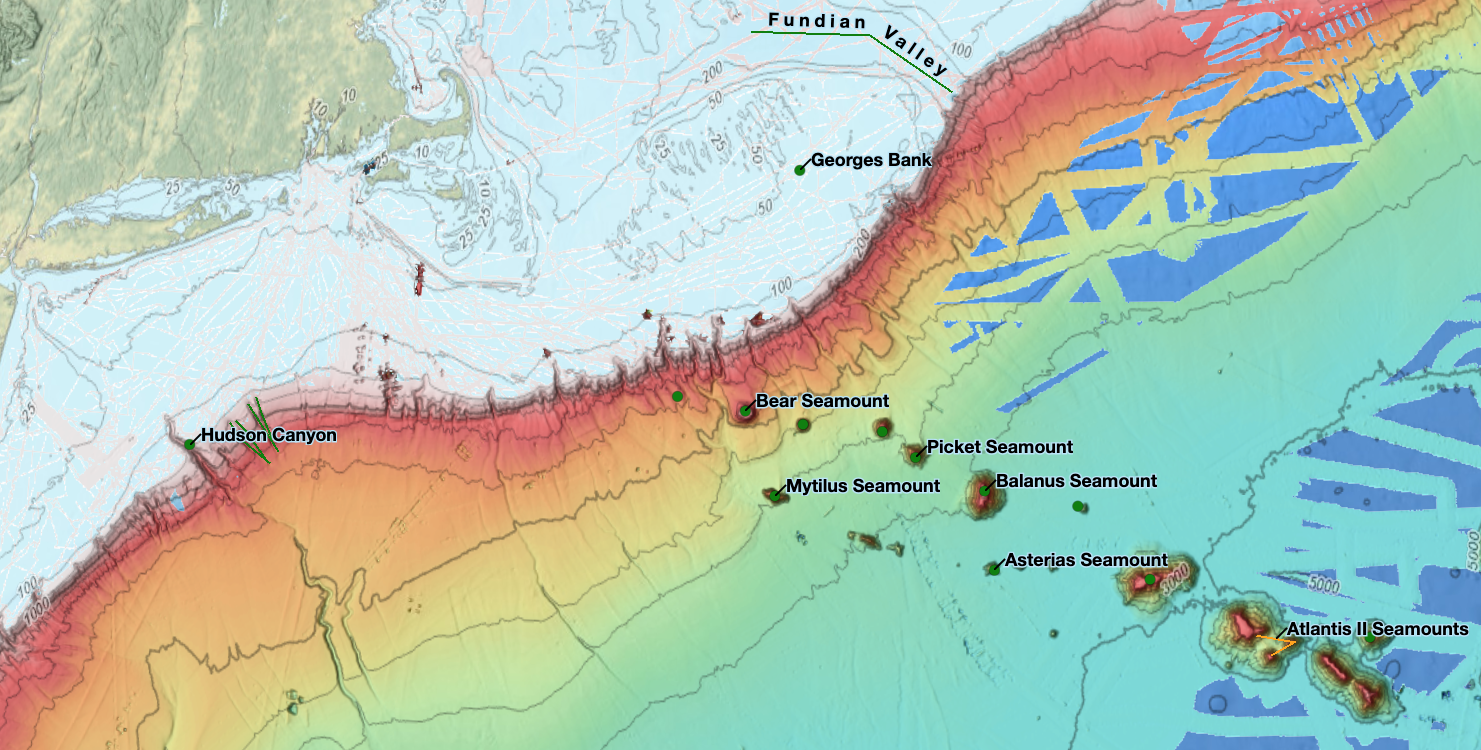
For more information on the New England seamounts check out this WHOI webpage.
Bear Seamount
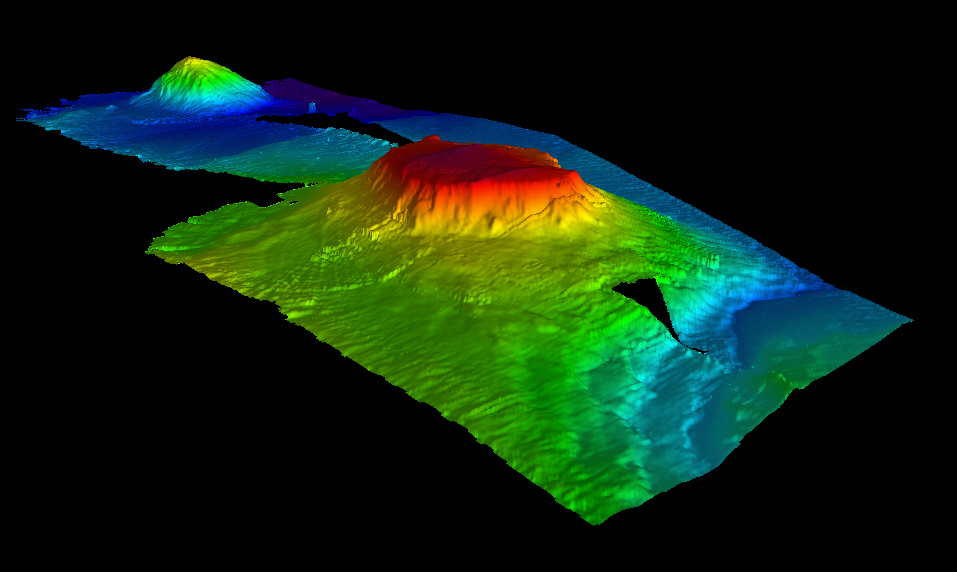
Bear Seamount is a flat-topped, extinct underwater volcano (guyot) located southeast of Georges Bank off Cape Cod, Massachusetts (39° 55’N 67° 30’W). It is the oldest and westernmost peak in the New England Seamount chain, and was last volcanically active during the Cretaceous Period, over 100 million years ago.
References Cited
Auster, P. J., Moore, J. A., Heinonen, K., and Watling, L. 2005. A habitat classification scheme for seamount landscapes: assessing the functional role of deepwater corals as fish habitat. In: Freiwald, A., Roberts, J. M., editors. Cold-water Corals and Ecosystems. Springer-Verlag; p 761–769.
Cárdenas, P., and Moore, J. A. 2019. First records of Geodia demosponges from the New England Seamounts, an opportunity to test the use of DNA mini-barcodes on museum specimens. Marine Biodiversity 49:163–174.
Kiraly, S. J., Moore, J. A., and Jasinski, P. H. 2005. Non-federally managed Atlantic deepwater and other sharks. Marine Fisheries Review 65(4):1–63.
Moore, J. A. et al. 2005. Selected fauna of Bear Seamount (New England Seamount chain) and the presence of “natural invader” species. Archives of Fishery and Marine Research 51(1–3):217–226.
Moore, J. A., Hartel, K. E., Craddock, J. E., and Galbraith, J. K. 2003. An annotated list of deepwater fishes from off New England, with new area records. Northeastern Naturalist 10(2):159–248.
Moore, J. A. et al. 2003. Biodiversity of Bear Seamount, New England seamount chain: results of exploratory trawling. Journal of Northwest Atlantic Fisheries Science 31:363–372.
Moore, J. A., Auster, P. J. 2009. Commensalism between juvenile cusk eels and pancake urchins on western North Atlantic Seamounts. Bulletin of the Peabody Museum of Natural History (Yale University) 50(2):381–386.
Quattrini, A. M. et al. 2015. Exploration of submarine canyons off the northeastern United States reveals dynamic habitats and diverse ecosystems. PLoS One 10(10):e0139904.
Rogers, A. D. 1994. Biology of seamounts. Advances in Marine Biology. 30:305–350.
Stabile, F. A. et al. 2017. Observations of wayward passerines and a falcon from a research vessel in the Western North Atlantic Ocean. Wilson Journal of Ornithology 129(2):349–353.