Research Interests
Florida Scrub Habitats
Overview of Florida Scrub Habitats
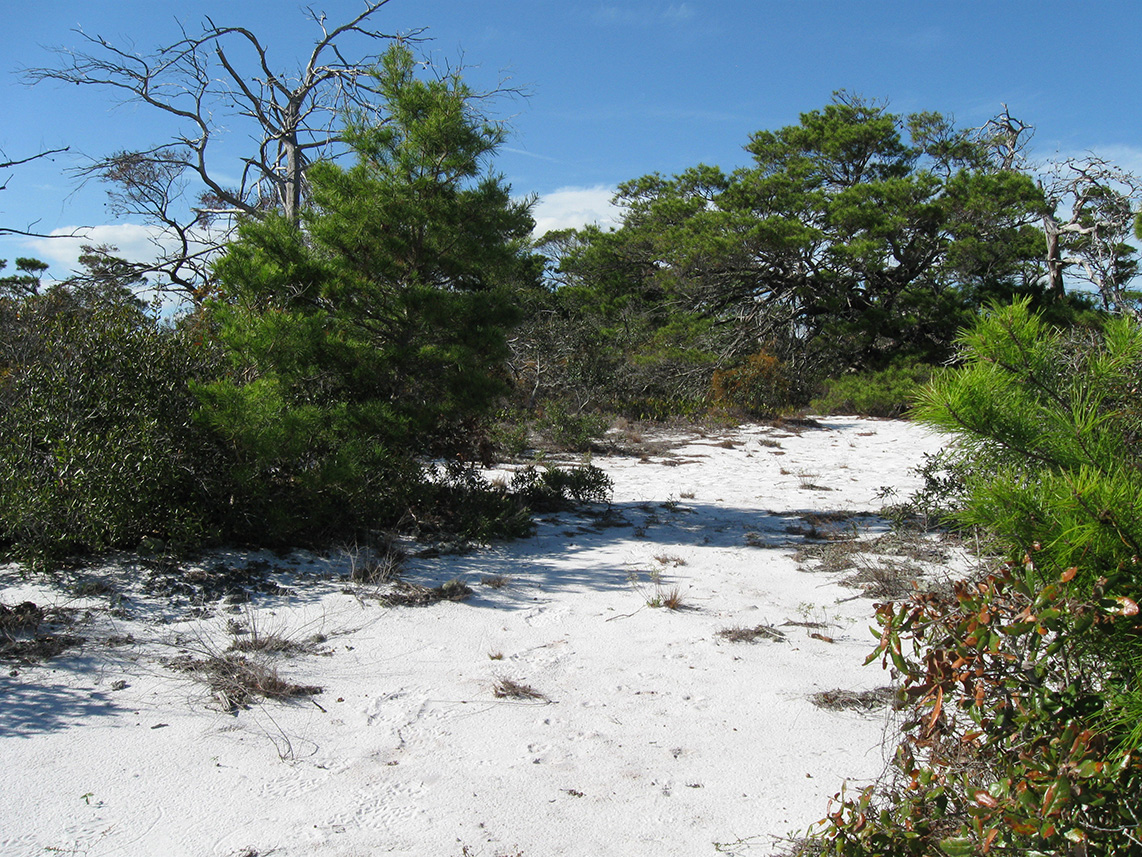
Some people are startled to find out there is a desert in such a humid and legendarily swampy place as Florida. This desert is not always obvious at first glance. From a distance it looks like stunted oak trees, sparse pines, and open sandy patches with low grasses and small plants. Take a walk in this scrub habitat, however, and you will quickly realize there are several different species of cacti, agave, yucca, and other plants adapted to dry conditions, along with various sand-dwelling animals that are typically found in the desert southwest of the United States.
Scrub habitat in Florida is a remnant of a different time and climate in the southern U.S. During the Pleistocene, when glaciers covered the northern part of the country, there was a band of dry habitat that wrapped from the southwestern states and Mexico around the northern Gulf of Mexico into Florida and across the sea to the Bahamas, Cuba and various other Caribbean islands. This dry band featured an entire desert fauna and flora.
The various changes in sea level during the Pleistocene left Florida with long ridges of sand created as dunes and barrier islands along the coast. As sea level dropped, these ridges became part of the mainland peninsula and home to the desert biota living in Florida. Today, we call this series of ridges parallel to the coastline the Atlantic Coastal Ridge system.
As the Pleistocene ended, conditions in many places in the northern Gulf of Mexico became wetter and this desert biota disappeared. In Florida, this biota survived on the highest sandy ridges, where rainwater quickly percolated through the coarse sand. Isolation from their relatives in the desert southwest allowed many of these Florida scrub plants and animals to evolve into endemic species.
In the 1894-5, when Henry Flagler built his Florida East Coast railroad south of Daytona to Palm Beach and eventually Miami, he often placed the railway line along these elevated ridges of sand. This location made sense because the ridges were less prone to flooding. However, the creation of the railway encouraged development immediately adjacent to the railroad stops. Homes, businesses, and farms quickly followed the building of the railway and this well-drained land remains premium in Florida today. Route US 1 and I-95 followed suit later, also often built on the ridges.
Unfortunately, scrub habitat has become rare in Florida, especially along the east coast, because of this development near the railroad and highways. Many endemic plants and animals are only found in scrub habitat, and as their habitat has diminished, so have their population numbers. My colleagues, students, and I are working to protect this habitat and inform the general public about the unique plants and animals along the Atlantic Coastal Ridge.
Research project on Harrisia fragrans
The fragrant prickly apple cactus, Harrisia fragrans, is a federally-listed endangered species of cactus only known from the scrub ridges and shell middens found along the Atlantic coast of Florida from Volusia County south to the Florida Keys. It gets its name for the large round red fruit it produces, as you can see in this photo.
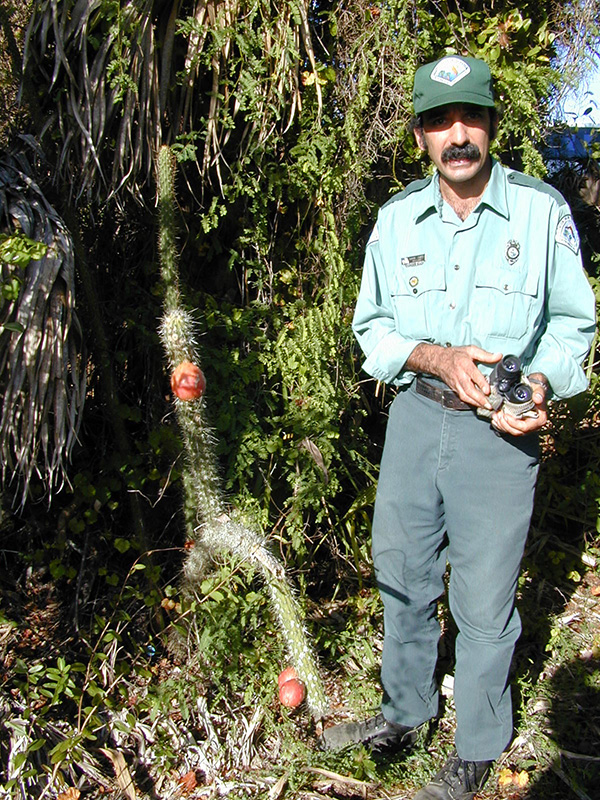
Because it grows in high, well-drained sands, many of the places it formerly grew have been developed and the cactus in those areas have been lost. Most of the remaining individuals can be found around Savannas Preserve State Park.
Moore, J. A. 2012. Notes on the biology of the fragrant prickly apple cactus (Harrisia fragrans). Palmetto 28(4):4-7. Available at: ResearchGate.
Research project on the Florida perforate lichen Cladonia perforata
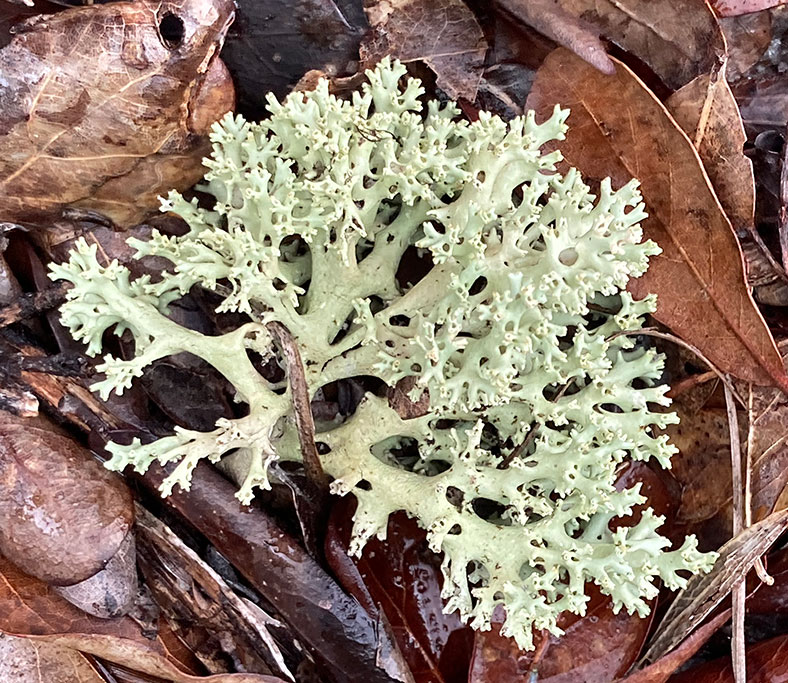
The Florida perforate lichen is a federally endangered species of ground lichen that occurs only in sandy scrub habitat. This species is only found in Florida, associated with sandy ridges that are former dunes and islands during previous high sea level stands. Dr. Susan Richardson and I have been investigating this lichen along the Atlantic Coastal Ridge on the east coast of Florida. Our recent surveys of the distribution of this species has documented 21 sites from Jensen Beach in Martin County to Jupiter in Palm Beach County. Some of these sites have as few as 75 pieces of lichen found there. However in other sites, this species can be locally abundant in small windblown patches.
Cladonia perforata is a true vagrant lichen, it grows unattached to any substrate and is moved about by wind (Rosentreter 1993). Like some other vagrant lichens in the genus Xanthoparmeliae, C. perforata has not been observed to reproduce sexually and it is thought that fragmentation plays a very important part in the ecology of C. perforata. Wind dispersal partially controls the distribution within sites. Many of the windblown pieces in drift accumulations were smaller pieces, which are more easily moved around. Pieces blown into the more open sandy areas also may be important for the survival of this species when fire occurs. We observed several unburned patches containing numerous small C. perforata pieces at some recently burned sites near Sandy Pines in Jonathan Dickinson State Park.