Teaching
Undergraduate Courses
Harriet L. Wilkes Honors College, FAU
Honors Marine Biology and Oceanography (OCB 3012). Discussions of major concepts of modern marine biology with emphasis on life in subtropical and tropical seas.
Honors Marine Biology and Oceanography Lab (OCB 3012L). Laboratories, including field studies and field trips of the varied marine habitats of southern Florida.
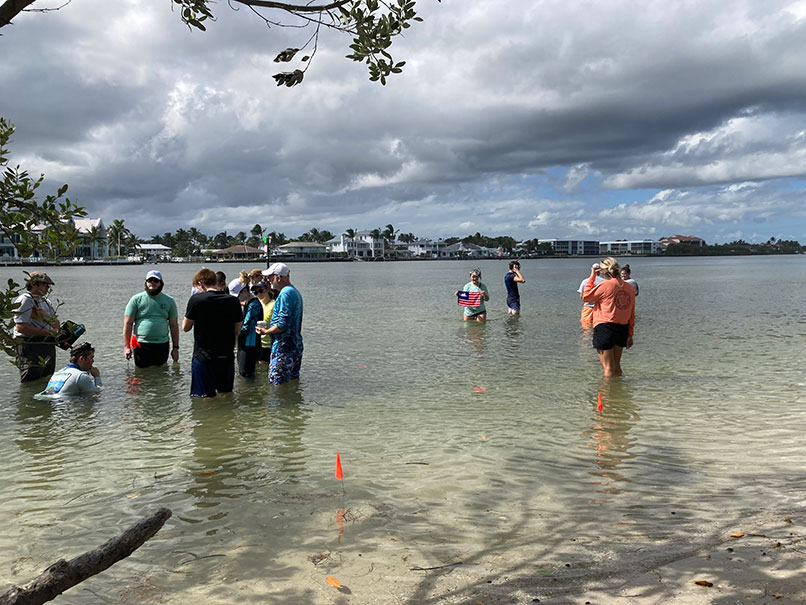
Marine Biology Lab Field Trip
Marine Biology Lab students censusing seagrass in Jupiter Sound, FL
Honors Coral Reef Ecology (ZOO 4556). Explores both the physical and biological aspects of coral reef ecosystems, including associated seagrass and mangrove habitats. Lectures and field trips are used to cover the ecologically relevant aspects of coral reef systems.
Honors Marine Conservation (EVR 4420). A one-semester, upper-level course in the scientific principles, ethics, legal issues, and management concerns of conservation biology in coastal and marine waters. Readings from scientific and policy literature will be discussed at length in class.
Honors Conservation Biology (EVS 4414). Course covers the principles, ethics, legal issues, and management concerns of conservation biology.
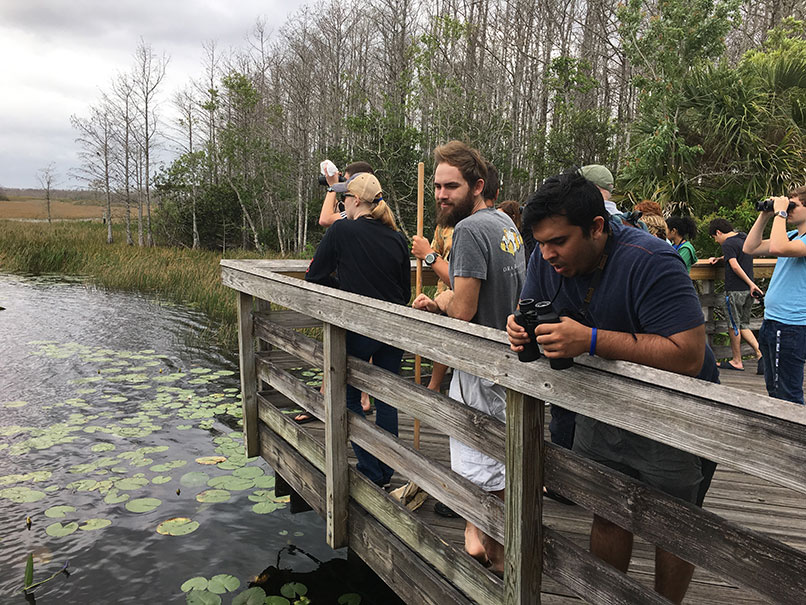
Conservation Biology Field Trip
Conservation Biology students on a field trip to the Grassy Waters Nature Preserve in Palm Beach County, FL
Honors Evolution of Life on Earth (GLY 4105). This is an interdisciplinary course combining topics from geology and biology. As such, it applies basic biological and geological principles such as evolution, ecology, plate tectonics and stratigraphy to understanding the complexity of life through time and the evolutionary and ecological processes that brought about those changes. The course reviews the evolutionary history of major groups of organisms as seen in the fossil record and major events such as the origins of life, the invasion of land, mass extinctions and climate changes.
Honors Deep-Sea Biology (BSC 4930).
Honors Ecosystems of Florida (BSC 4930).
Honors Biology of Fishes (BSC 4930).
Honors Biology of Fishes Lab (BSC 4930).
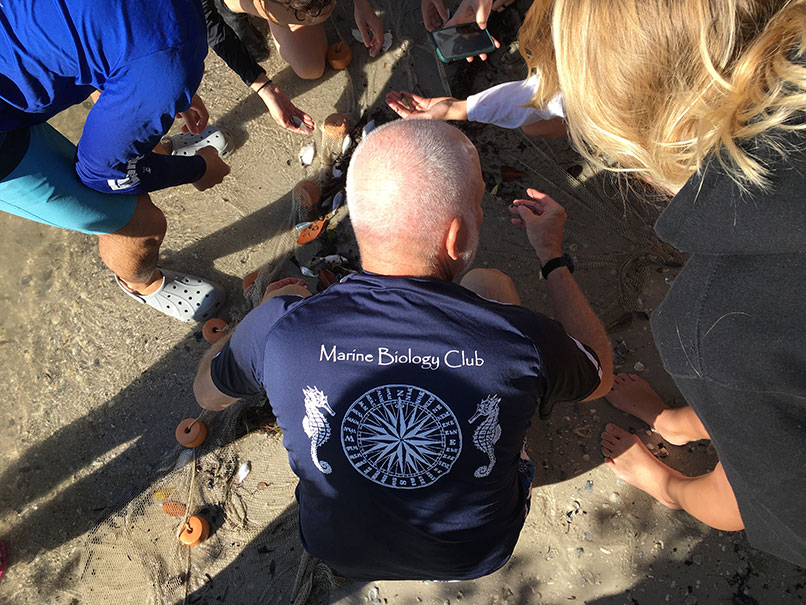
Biology of Fishes Lab Field Trip
Dr. Moore showing fish to students from Jupiter Sound, FL
Honors Vertebrate Zoology (ZOO 2303). A study of the structure, relationships and natural history of the vertebrates with special emphasis on the ecology of subtropical and neotropical species.
Honors Lab for Vertebrate Zoology (ZOO 2303L). A laboratory examination of selected topics in the biology of vertebrates, including formal surveys of the taxa and occasional weekend field trips.
Honors Audubon’s Nature (IDS 3131c). This is an interdisciplinary course on scientific illustration that is co-taught with Prof. Dorotha Lemeh, one of the art professors. Students illustrate natural history objects collected during field trips to the Abacoa Greenway, and to Coral Cove Park on Jupiter Island.
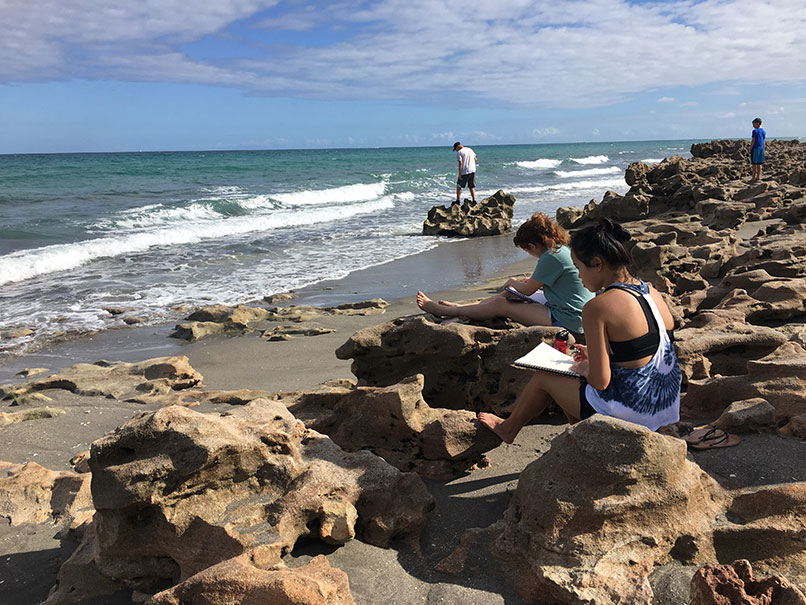
Audubon's Nature Class
Students in the Audubon's Nature class sketching marine organisms at Coral Cove State Park on Jupiter Island, FL
Honors Environmental Science & Sustainability. This course is a survey of basic chemical, biological and physical principles of environmental science and their applications to environmental issues. This course is appropriate for students in a wide range of disciplines or programs. This is a General Education course.
Honors Animal Behavior (PCB 3411). A one-semester, advanced-level course that surveys modern approaches to the study of animal behavior, emphasizing the integration of ecological, evolutionary, ethological, and physiological approaches.
Honors Evolution (PCB 4673). An in-depth examination of the mechanisms that operate in the evolutionary process.
Honors Freshman Seminar: Ecology of Atlantic Shores (BSC 1933). Special topics course for freshmen on the marine ecology of Atlantic coastal habitats.
Honors Freshman Seminar: Biology of Birds (BSC 1933). Special topics course for freshmen on ornithology.
Honors Introduction to Geographic Information Systems (co-taught with Bill O’Brien) (IDS 3932). This course introduces students to principles and applications of geographic information systems, emphasizing key concepts related to data capture and management, map design, production, and analysis. Students will pay a nominal lab fee that will cover costs of printer paper and ink.
Honors Scientific Writing I (ISC 2932). This class covers the essentials of scientific writing in theory and in practice.
Honors Math & Science Seminar (co-taught with Ryan Carr, Michelle Ivey or Gene Smith) (ISC 3933). An interdisciplinary seminar designed primarily for students concentrating in science and math, this course is open to both juniors and seniors. It provides preparation for developing a senior thesis proposal. Students should enroll for this course in the year prior to the academic year that they will begin their thesis.
Honors Math & Science Internship (ISC 4947 ). Provides students with an opportunity to gain first-hand experience in science and mathematics beyond the university, for example, in a government or corporate setting. It contributes to the mission of the Honors College by encouraging students to explore interdisciplinary connections in their work and to discuss these in a detailed essay.
Honors Research in Biology (BSC 4970). In conjunction with the advisor, the student selects and evaluates materials related to an area of interest in biology.
Honors Thesis in Biology (BSC 4915). In conjunction with the advisor, the student writes a senior research paper describing and summarizing the results of their thesis research.
Directed Independent Study (BSC 4905). Students work with research mentors to conduct research and inquiry in Biology.
Honors Thesis in Environmental Studies (EVR 4970). In conjunction with the advisor, the student writes a senior research paper describing and summarizing the results of their thesis research.
Honors Anatomy and Physiology I (BSC 2093). This course is the first part of a two-semester sequence in which students examine human anatomy and physiology through a systems approach based on the interaction between form and function, from the microscopic components of cells and tissues to the organismal level. Emphasis is placed on histology and the integumentary, skeletal, muscular and nervous systems.
Honors Anatomy and Physiology I Lab (BSC 2093L). Laboratory experiments to augment teaching in BSC 2093.
Honors Anatomy and Physiology II (BSC 2094). This course is the second part of a two-semester sequence in which students examine human anatomy and physiology through a systems approach based on the interaction between form and function, from the microscopic components of cells and tissues to the organismal level.
Honors Essentials of Anatomy and Physiology (BSC 2084). A one-semester course in human anatomy and physiology.
Honors Anatomy and Physiology II Lab (BSC 2094L). Laboratory experiments to augment teaching in BSC 2094.
Honors Essentials of Anatomy and Physiology Lab (BSC 2084L). Laboratory experiments to augment teaching in BSC 2084.
Graduate Courses
Department of Biological Sciences, FAU
Master’s Thesis Proposal (BSC 6905). The student is guided by the advisor and Graduate Supervisory Committee on the proposal's format that is best suited to the student's discipline, following the Graduate College's formatting requirements. The student adheres to all thesis proposal procedures and the timeline. The student presents the seminar to an open audience and the Graduate Supervisory Committee asks questions on the proposal and decides if it warrants approval.
Master’s Thesis Research (EVR 6971). This course is intended for graduate students conducting original research on their master's thesis topic.
Master’s Thesis Defense (BSC 6905). The student is guided by the advisor and Graduate Supervisory Committee on the proposal's format that is best suited to the student's discipline, following the Graduate College's formatting requirements. The student adheres to all thesis defense procedures and the timeline. The student presents the seminar to an open audience, and the Graduate Supervisory Committee asks questions on the results and defense and decides if it warrants approval.