Research Interests
Florida Reptiles & Amphibians
Florida has an amazing diversity of native reptiles and amphibians, plus a huge variety of introduced species have added greatly to the overall diversity. There is still much to learn about the ecology of these species and what impacts the introduced species have. My students and I have been surveying the diversity of herps at several sites and examining the interactions between native vs. invasive species and even invasive vs. invasive.
Invasive Curly Tail Lizards (Leiocephalus carinatus)
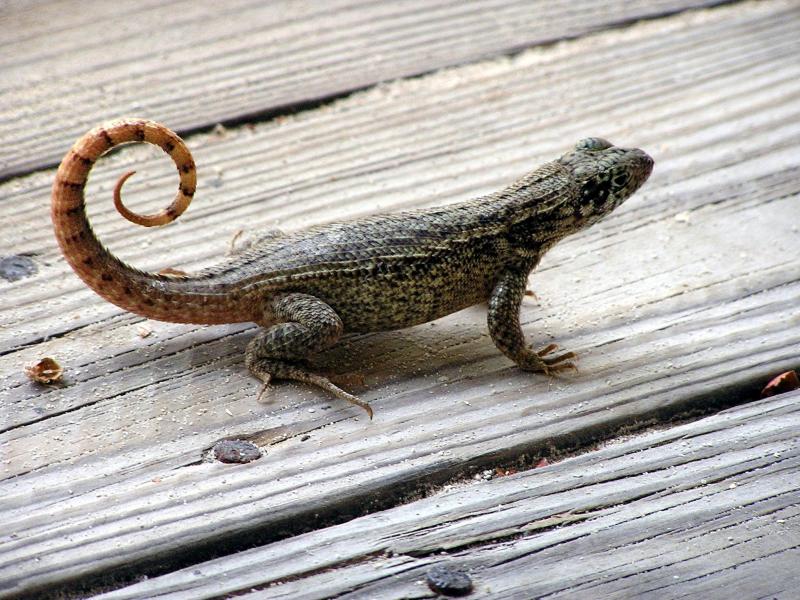
The northern curlytail lizard (Leiocephalus carinatus armouri) is an invasive species of larger aggressive ground lizard, native to the northern Bahama Islands. It was originally introduced into South Florida in the 1940s when 20 pairs were released at an estate on Palm Beach Island. Since then, they have spread onto mainland Florida and extended their range south to the Florida Keys and north to Indian River County (Meshaka et al. 2005; J. Moore personal observation). In its native habitat, it burrows in sand underneath coral rocks. Here in the east coast of Florida, any place with sand underneath concrete, especially sites with nearby plantings of shrubs for cover from predators, serve as a suitable habitat. So, this lizard is frequently found in heavily urbanized areas, with the main north-south dispersal corridors along routes US 1 and A1A. This preference for urbanized areas does not exclude this lizard from wilder habitats, however. I have observed curlytail lizards diving into gopher tortoise burrows in a few different nature preserves.
Peter’s Rock Agama (Agama pictacauda)
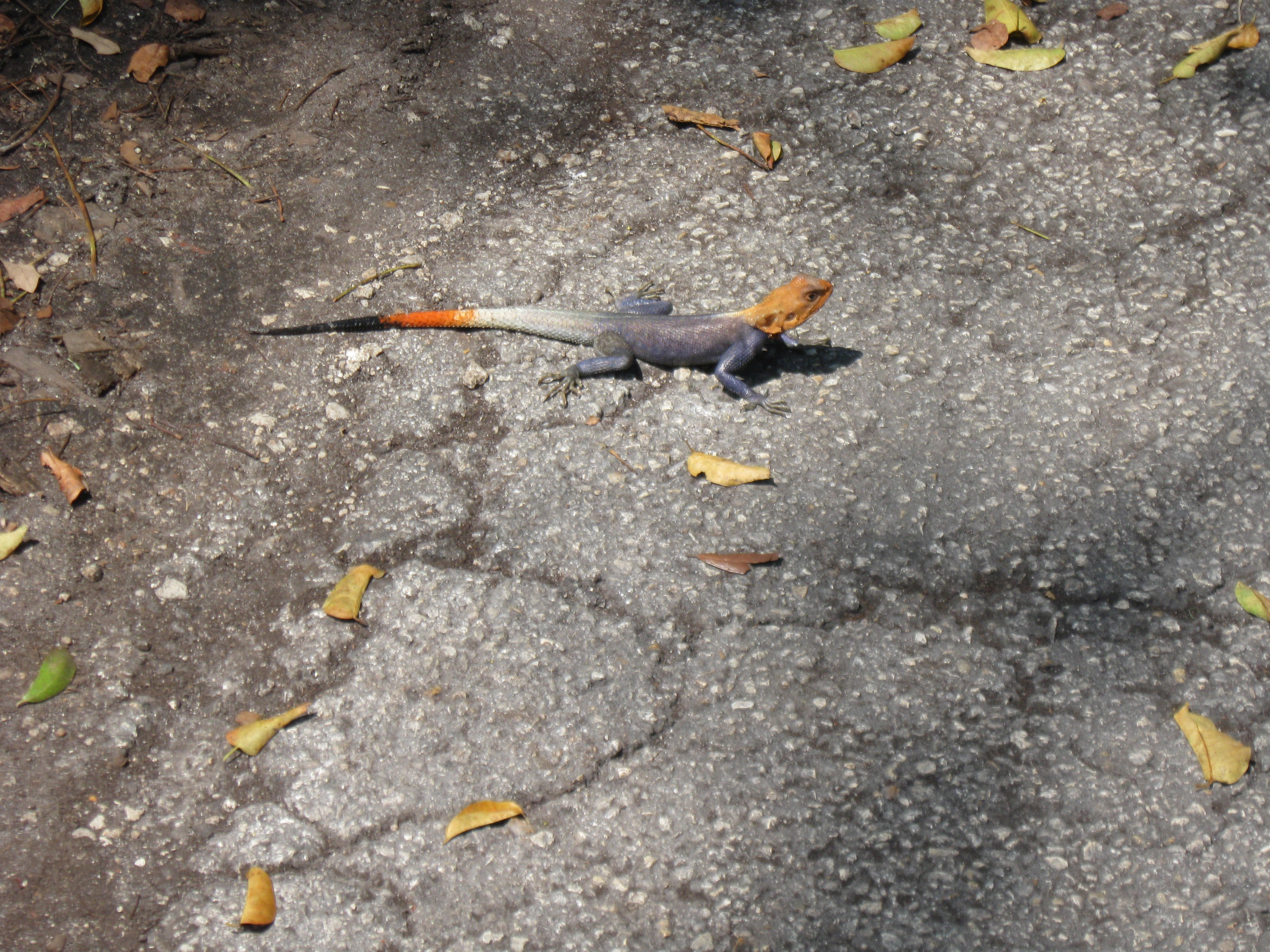
The Peter's rock agama (Agama pictacauda) is another large invasive ground lizard native to west Africa. It was originally introduced into Florida by reptile breeders. In 2013, I noticed individuals in a parking garage adjacent to the Wilkes Honors College in Palm Beach County. Subsequently, the lizards began to appear in parking lots, rest areas, and near dumpsters. Given these earlier observations and a direct observation of an agama falling from the underside of a van on I-95 (Moore 2019), it appears that both agamas and curly-tail lizards have expanded their ranges in Florida by hitchhiking on the undersides of cars and trucks.
Invasive Geckos
There are two invasive species of geckos, Hemidactlyus mabouia (African wood gecko) and H. garnotii (Indo-Pacific house gecko) in south Florida. My students have surveyed population numbers of these geckos on buildings on the Wilkes Honors College campus. On buildings that host only the two species of geckos, the African wood gecko outcompetes the Indo-Pacific house gecko. However, on building with both geckos and Cuban tree frogs, the tree frogs prevent the wood geckos from becoming dominant (Meshaka et al. 2020, 2006; Voirin 2016; Kingsland 2007).
References Cited
Goethel, C. A., H. T. Smith, and J. A. Moore. 2007. Ophisaurus ventralis (Eastern Glass Lizard). A review of road-kill mortalities and occurrence in Florida with notes on an unusual event. Journal of Kansas Herpetology 22:13.
Herr, J. S., and Moore, J. A. 2019. Leiocephalus carinatus armouri (Northern Curlytail Lizard) Predation. Herpetological Review 50, no. 2:374–75.
Kingsland, K. 2007. Assemblage dynamics of exotic herpetofauna on Jupiter Campus of Florida Atlantic University. Honors Senior Thesis, Harriet L. Wilkes Honors College, Florida Atlantic University, 2007. Available at: FAU Digital Libary.
Meshaka, W. E., M. L. McCallum, C. Voirin, and J. Moore. 2020. The Cuban treefrog (Osteopilus septentrionalis) dampens competitive superiority between two gecko species on buildings. Urban Herpetology 34: 1–10.
Meshaka, W. E., Jr., H. T. Smith, R. M. Engeman, C. L. Dean, J. A. Moore, and W. E. O’Brien. 2005. The geographically contiguous and expanding coastal range of the northern curlytail lizard (Leiocephalus carinatus armouri) in Florida. Southeastern Naturalist 4(3):521-526.
Meshaka, W. E., Jr., H. T. Smith, E. Golden, J. A. Moore, S. Fitchett, E. M. Cowan, R. M. Engeman, S. R. Sekscienski, and H. L. Cress. 2007. Green iguanas (Iguana iguana): unintended consequence of sound wildlife management practices in a South Florida park. Herpetological Conservation and Biology 2(2):149-156.
Meshaka, W. E., H. L. Cress, K. L. Kingsland, H. T. Smith, S. A. Fitchett, J. A. Moore and E. M. Cowan. 2006. Hemidactylus (house gecko) assemblage dynamics on South Florida buildings. Journal of Kansas Herpetology 17:14-15.
Moore, J. A. 2008. Arboreality in the northern curlytail lizard (Leiocephalus carinatus armouri). Journal of Kansas Herpetology 28:17-18.
Moore, J. A. 2019. Agama picticauda (Peter’s Rock Agama) dispersal. Herpetological Review 50, no. 2: 360.
Moore, J. A., A. C. Hipps, C. Reiland-Smith, and L. Fremont. 2017. Leiocephalus carinatus (Northern Curlytail Lizard) gopher tortoise burrow associate. Herpetological Review 48, no. 4: 848.
Moore, J. A. and H. T. Smith. 2006. Roadways and sidewalks into natural areas: a warning. Natural Area News 10(3):4.
Moore, J. A., H. T. Smith, and R. M. Engeman. 2005. Eastern glass lizard (Ophisaurus ventralis). Predation. Herpetological Review 36:182.
Moore, S.L., J.A. Moore and S.L. Richardson. 2009. A new allopatric population of northern curlytail lizard (Leiocephalus carinatus armouri) in Ft. Pierce, Florida. Bulletin of the Peabody Museum of Natural History (Yale University) 50(1):21-25.
Smith, H. T. and J. A. Moore. 2009a. Leiocephalus carinatus armouri (Northern Curlytail Lizard). Mortality [of colony]. Herpetological Review 40(1):87-88.
Smith, H. T. and J. A. Moore. 2009b. Leiocephalus carinatus armouri (Northern Curlytail Lizard). Predation [by domestic dog]. Herpetological Review 40(1):88.
Voirin, Connor. 2016. Interspecies interactions between Hemidactylus mabouia, Hemidactylus garnotii, and Osteopilus septentrionalis. Honors Senior Thesis, Harriet L. Wilkes Honors College, Florida Atlantic University, 2016. Available at: FAU Digital Library.